Showing posts with label landscape photography. Show all posts

Tuesday, 21 February 2017

Hatterall - Hill towards the sun

The Hatterall ridge looking north from its southern-most point at Trewyn 'hill fort'.

The Hatterall, or versions of it, is a long-standing name used in times past for the eastern uplands of the Black Mountains, now used more particularly for the heights between the Vale of Ewyas and the valleys of the Monnow and Olchon; a ridge that carries both the England-Wales border and the Offa's Dyke National Trail. The Welsh names of hills and mountains typically have fairly prosaic meanings (though rendered more exotic to English ears) - 'big hill', 'top of the hill', 'great mountain' and such-like. In contrast, Hatterall has an interesting and varied etymology as it has evolved from its (probable) lyrical origins to its puzzling Anglo-Welsh hybrid present. As the examples below demonstrate, there have been many variations in documents, books and maps as use by non-literate cultures, misunderstandings, mishearings and Anglicisation have morphed and moulded the words through the centuries.


A borderland: Offa's Dyke path above Llanthony, looking south.

At y Heu (probable original name, though undocumented - 'hill towards the sun' in Welsh)

 Hatiram (1137)

  Hatyre (12th century)

    Hateroll (1325)

      Haterhill (1566)

        Hatherall (1574)

           Hattrell (1612)

             Hatyrel, Hatterras (1905)

               Hateral, Hatterrall (20th century)

                  Hatterall Hill or The Hatterall (modern name - 'hill towards the sun hill'!)


The Black Darren land-slip in the Olchon Valley.


Above the Cwm-iau valley.

The steep eastern slopes of Hatterall above Oldcastle.

Stone wall alongside the Beer Path from Llanthony up to the Hatterall ridge.

A distant Llanthony Priory from the high boundary of Walter Savage Landor's park on the slopes of Hatterall.

Friday, 22 April 2016

Ultima Thule


'Concerning Thule, our historical information is still more uncertain, on account of its outside position; for Thule, of all the countries that are named, is set farthest north. 'Strabo, Geography, 1st century BC

The term 'Ultima Thule' was used in Classical and medieval geographical writing to describe mysterious places in the distant north beyond the known world of trade, empire and civilisation. Since the first use of the concept by the Greek explorer Pytheas debate has raged as to whether the phrase refers to Norway, Greenland, Iceland, Orkney, Shetland or, perhaps more likely, an amalgam of all dimly known northern climes. Having just spent several days in the unambiguously epic and often thrillingly peculiar landscapes of Iceland I can only back its candidature to be the very embodiment of Ultima Thule.


'It is no use trying to describe it, but it was quite up to my utmost expectations as to strangeness: it is just like nothing else in the world.' 
William Morris on his first visit to Iceland (1877)
As with Morris, my words can only pale in the face of a first sighting of Aurora Borealis, the Northern Lights, and the other wonders of the trip, so here is a visual montage of 'the place where the sun goes to rest.' (Geminus of Rhodes, 1st century BC).


'Thule; an island in the Ocean between the northern and western zone, beyond Britain, near Orkney and Ireland; in this Thule, when the sun is in Cancer, it is said that there are perpetual days without nights.'
Servius, 4th century AD


'By a route obscure and lonely,
Haunted by ill angels only,
Where an Eidolon, named Night,
On a black throne reigns upright.
I have reached these lands but newly
From an ultimate dim Thule –
From a wild weird clime, that lieth, sublime,
Out of Space – out of Time.'
Extract from Edgar Allan Poe's poem Dream-Land (1844)


'(Auden) said that Iceland was like the sun that had set, (but) you could see the sunshine on the mountains: Iceland followed him like that - the colours of the setting sun on the mountains. He said that he was not always thinking about Iceland ... that he was never not thinking about Iceland.'
Simon Armitage and Glyn Maxwell, Moon Country (1996)


Tuesday, 8 September 2015

Richard Long: 'Time passes. A place remains.'

"A good work is the right thing in the right place at the right time. A crossing place."
Richard Long, 1980

The Arnolfini gallery in Bristol is currently hosting an exhibition of the work of Richard Long, entitled Time and Space. As a native Bristolian, works from the city and the South West are well-represented as are those from further afield, from all seven continents in fact.

His, often ephemeral, sculptures, photographs, textworks and other creations could be classified as land art or art made by walking or even (God forbid) psychogeographical art. As with other artists who use landscape as a touchstone and a material, such as Andy Goldsworthy, Michael Heizer, Walter de Maria, Jeremy Deller and Richard Skelton, his output seems refreshingly straight-forward and free of dogma, unnecessary theorising and cant. It has a felt and intelligent simplicity. However, I will leave it to the words and work of Richard Long himself to convey how he uses materials in the landscape, walking and place itself to create his art.

"They are a sort of simple celebration of place, like its stones, or the horizon, or the mist, and of me being there, at that particular time, possibly never to pass that way again. I sometimes think of these works as songs."    
Richard Long, 2014


I like simple, practical, emotional,
quiet, vigorous art.

I like the simplicity of walking,
the simplicity of stones.

I like common materials, whatever is to hand,
but especially stones, I like the idea that stones
are what the world is made of.

I like common means given
the simple twist of art...

...I choose lines and circles because they do the job.

My art is about working in the wide world,
wherever, on the surface of the earth...

...I use the world as I find it...

...My outdoor sculptures and walking locations
are not subject to possession and ownership, I like the fact
that roads and mountains are common, public land.

My outdoor sculptures are places.
The materials and the idea are of the place...

...A walk expresses space and freedom
and the knowledge of it can live
in the imagination of anyone, and that
is another space too.

Extracts from:
'Five, six, pick up sticks
Seven, eight, lay them straight' (1980)


A footpath is a place.
It also goes from place to place, from here to there, and back again.
Any place along it is a stopping place...

...There is an infinite and cosmic variety of journeys, at all scales...

Notes on Paths, 1999


Art is a formal and holistic description of the real space and experience of landscape and its most elemental materials.

Royal West of England Academy, 2000


A text is a description, or story, of a work in the landscape. It is the simplest and most elegant way to present a particular idea, which could be a walk, or a sculpture, or both.
Extract from Notes on Works, 2000


References

Lailach, Michael, 2007. Land Art. Cologne: Taschen.

Long, Richard, 1997. A Walk Across England. London: Thames & Hudson.

Roelstrate, Dieter, 2010. Richard Long: A Line Made by Walking. London: Afterall.
Tufnell, Ben (Ed.), 2007. Richard Long: Selected Statements & Interviews. London: Haunch of Venison.

Richard Long: Time and Space. Exhibition guide, 2015.


Friday, 21 August 2015

The mountains of Arran: a landscape of wonder within reach


"My place above every other place
to be on your high shoulder-blades
striving with your rocky great grey throat"
The Cuillin, Sorley MacLean

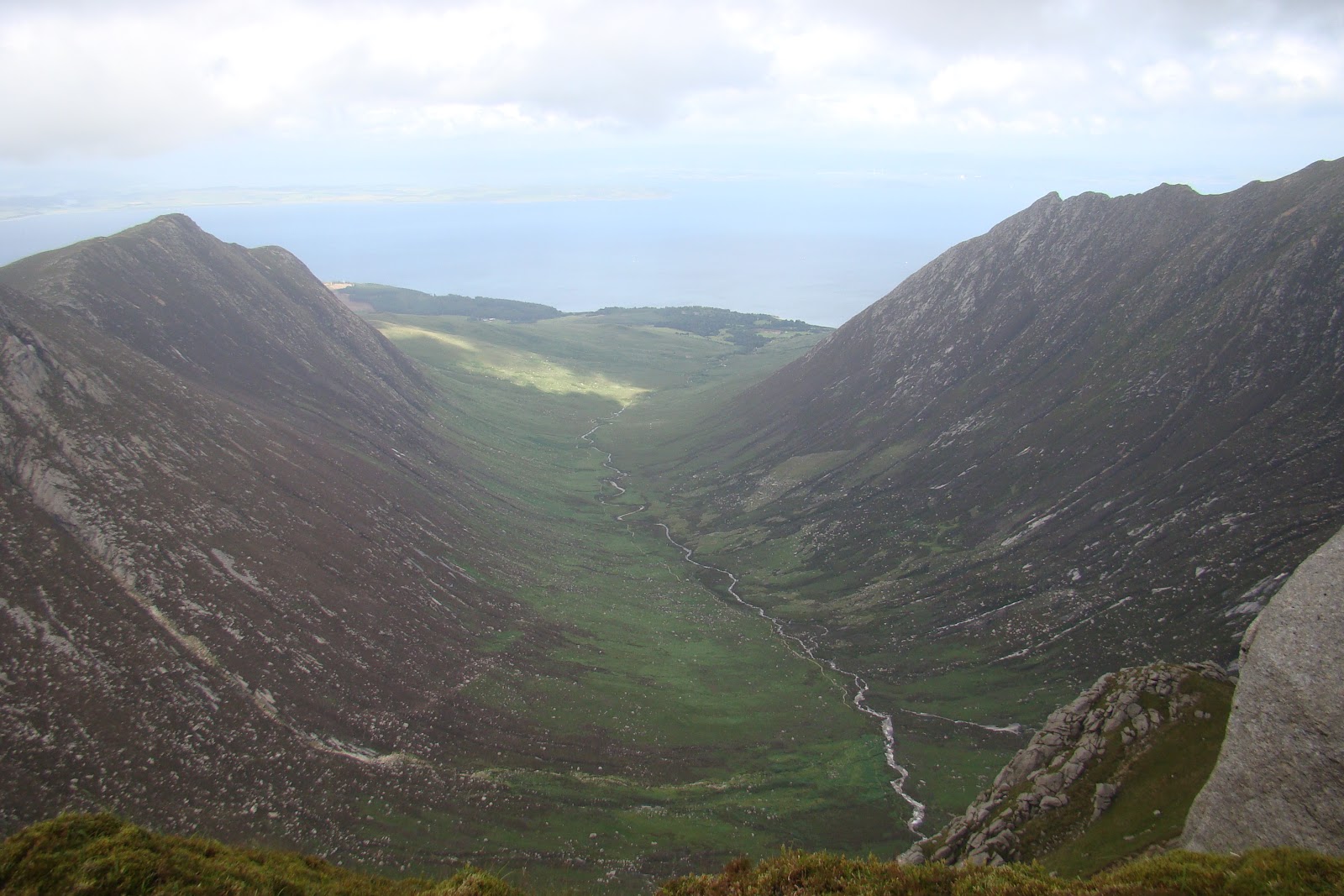
The beginnings play out the familiar rhythms of the start to a day in the mountains. Shaking off car park lethargy with a steep - initially conifer-shrouded - ascent, cresting to a suddenly wide-screen terrain, taking in the always wonder-capturing first vista with heavy breath then a washing-over of the stoic reserves required for the upward progression to the initial peak. 

The rising rock-scape in question is Goat Fell, at 874 metres the highest point of the mountain range that bosses the northern half of the Island of Arran, a hypereal mirage of jagged horizons seen across the Firth of Clyde from the drab mainland reality of the port of Ardrossan and post-industrial North Ayrshire (post-industrial being, of course, a bogus alias for places - and people - that have been used, spat out and apparently no longer matter).


For once the opportunity had arisen to pass over the usual horse-shoe circular movement in favour of a less predictable linear upland journey: ten miles or so of high level tramp from the Victorian Laird-land of Brodick Castle to the sheltered bay of Lochranza on the northern coast (famous as the landing point of Robert the Bruce on his return to Scotland in 1306 and as a site of the geologically important Hutton's Unconformity)  A clear forecast after several dreich days means that the climb to Goat Fell is well populated in both directions. Up and over and the descent to the exposed ridge of Stacach sees the masses dwindle to the occasional fellow wayfarers, then a morphing into a facsimile (for it is nothing more) of wilderness, with no sightings of a human being in the final three hours of the walk.


Picking a route down to the dispiritingly low pass of The Saddle and Geography lesson perfect glaciated valleys fan in all directions. Looming ahead and then above is the seemingly unbreachable massif of Cir Mhor ('big comb' due to its resemblance to a cockscomb, the crest of a domestic cock). The thin line of a path up the mountain-side traced from afar is now out of sight. The unlikely smallness of the gravel track commencement of the climb requires faith and experience to envisage it as a way to scale the looming heights. After the so-so summit of Goat Fell (the highest point of a range is rarely the most memorable), Cir Mhor is a revelation of a mountain; the apex of an X-shaped quartet of ridges. A high terrain that seems more Pyrenees or Dolomite than Scottish Highland, with light grey granite tors resembling massive Inca walls (or perhaps a pneumatic Dartmoor): the Andean ambiance bringing to mind the opening scene of Werner Herzog's Aguirre, The Wrath of God, a caravan of conquistadors and their Queshua slaves descending a mist-shrouded Huayna Picchu on their doomed search for El Dorado. 


Looking back from the curva-like ridge approaching the final peak of the day, Caisteal Abhail, and the dragon's back route from Goat Fell appears in sharp relief. Atop and gazing in the opposite direction and the day's destination, Lochranza, appears for the first time; a balm for heavy legs but a hazy blue horizon still four miles distant. 

High-rolling days like these need to be cherished. Not because they represent a tired macho peak-bagging mentality or some nebulous concept of wilderness; its more simple than that: they are a reminder that landscapes of wonder are within reach.


Sunday, 18 January 2015

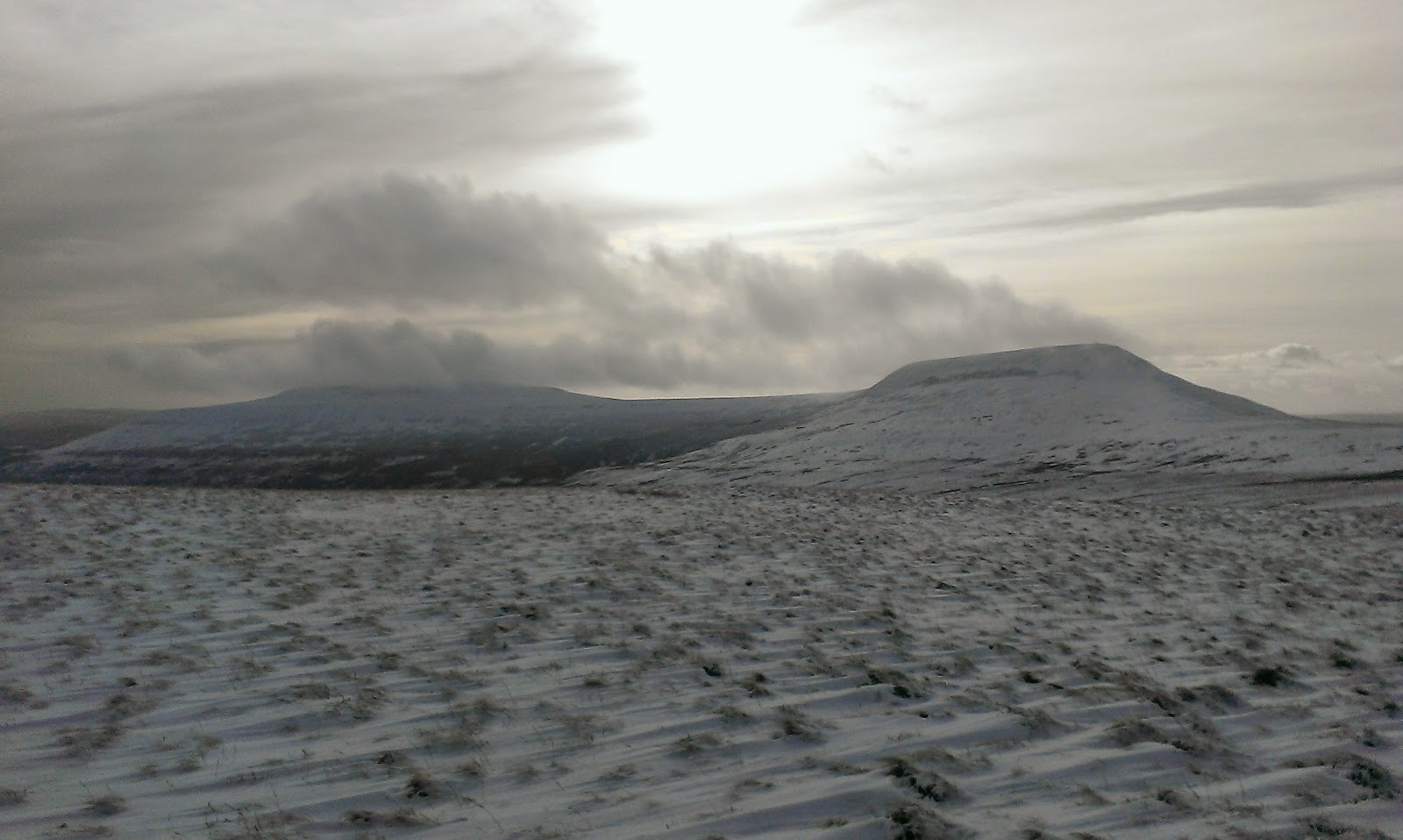
'And far away a mountain zone ...'


"And far away a mountain zone,
A cold white waste of snow-drifts lies"
Speak of the North, Charlotte Bronte

The new year's first encounter with a snowscape, and its the exceptional array of colour that fixes in the memory: the white and grey shades of the snow and sky a counterpoint to the tawny russet and sodden green of the hillsides. The winter sun seems to bring urgency to its brief displays and, filtered through cirrus and mist, its light pulls the life up out of a landscape that could otherwise appear drab and dormant at this time of year. 


Here in the Black Mountains the snow line is above about 300 metres; thick, dominant and drifting on the tops and slopes facing north and west into the weather front, more fleeting and peripheral on more sheltered ground. Long views become visions of coalescence: if not exactly the Antarctic vastness of H.P. Lovecraft's At the Mountains of Madness, there is the same "tendency of snowy earth and sky to merge into one mystical opalescent void with no visible horizon to mark the junction of the two".   


Up on the Pen Allt Mawr ridge, in Edward Thomas' 'great silence of snow', the whiteness is satisfyingly deep and proper; every footstep crunching in line with our childlike expectation of how snow should be, innocent of slush and dirt and imminent waning.


One of the many joys of a landscape visited by snow is the shape-shifting quality it can bring to familiar features.

The stone of a usually welcoming summit shelter, now a threatening ice-bound realm.  

  
A fallen tree cloaked in snow, with strangely human lines; from the mind of Andy Goldsworthy.


A trig point looming out of the cloud becomes a thing of ghostly sentinel reassurance amidst the enveloping whiteness.
  
Though walking in wintry conditions requires care and knowledge, in the words of R.S. Thomas snow feels no pity, it can also be a welcoming host; on heather uplands the thin dotted green or black path lines on the map become gleaming white high ways on the ground, illuminating the route ahead. This snowy benevolence enhanced by the boot tracks that give confidence of the right path taken (assuming a lost soul is not being followed). On this occasion the hard stamped marks of a fell runner anticipated my route, the same circuit completed in reverse.


And, in this far away mountain zone, how does it feel? It feels like I don't ever want to come down.