Showing posts with label gardening. Show all posts

Wednesday, 1 April 2020

Gardens where we feel secure


Glass half-full, the Covid-19 restrictions on movement coinciding with the first burst of spring present an opportunity to inhabit the topography of your own garden more profoundly than in normal times, if you are lucky enough to have outdoor space. This is always the favoured season to tidy up, prepare, potter and observe my own modest though ample plot. The fact that the family cats now have a wider right to roam than us human residents means that the garden's function as the micro-landscape of daily life is amplified as never before, its role as play area and nature haven in an urban setting intensified by the prohibition of regular wandering beyond its borders; not quite perhaps Samuel Taylor Coleridge's elegiac incarceration (This Lime-Tree Bower My Prison) but a welcome and welcoming open prison of greenery. As Coleridge had it, 
No plot so narrow, be but Nature there,
No waste so vacant, but may well employ
Each faculty of sense, and keep the heart
Awake to love and beauty!


We have been temporarily exiled from national parks, hills and mountains, landmark landscapes and the wider countryside, National Trust gardens are closed and even time spent in local parks and open spaces is heavily prescribed. But, whilst few of us have gardens on the scale of a Kelmscott, Sissinghurst or Great Dixster to wander whilst the day wanes, our own modest plots can provide much solace (my impression, also, is that people around here are engaging anew with the green spaces within walking distance of their homes, as the option of jumping in the car to drive out to more celebrated landscapes - or indeed to engage in more consumerist pastimes - is off limits).


I've been to a minor place
and I can say I like its face,
If I am gone and with no trace
I will be in a minor place

Bonnie 'Prince' Billy - A Minor Place


Bounded ranging around this relatively small space, this minor place, allows close and regular looking with an intensity not normally available as busy lives carry us away to work and obligations and pleasure elsewhere. Rudyard Kipling was correct: 'the Glory of the Garden lies in more than meets the eye.' In a previous post (The last field in England), I mused on the reward that can be gained from deep concentration on a small area of topography:
'There is something both inviting and slightly daunting in the thought of studying the micro-landscape of a single field. A small matter for a master such as Richard Jefferies who can devote a whole chapter to dwelling on the minutiae of the topography, flora and fauna of the 'homefield' in Wild Life in a Southern County, but more of a challenge to most of us, lacking the innate knowledge of the Victorian country-dwelling naturalist. Nevertheless, it is an approach that retains its appeal, witness Tim Dee's recent Four Fields, an expansive study of the geography, history, literature and ecology of varying, and admittedly atypical, areas of fields in the Fenland of Cambridgeshire, Zambia, Ukraine and Montana, USA; or The Plot by Madeleine Bunting, 'a biography of an English acre, rooting a story of family history in a very particular place' (not to be confused with Andrew Michael Hurley's novel Starve Acre, also Yorkshire-sited though a tale of obsession with a more unhallowed patch of ground). Such an approach can also be applied to a garden: a place to work, rest and observe, to tend and derive wonder.


In this garden, just beyond the confined technology and 'civilisation' of the house, everyday encounters with wildness can and do take place. The pond now teems with tiny tadpoles released from the frogspawn which appeared at the end of February (a little earlier than normal?) as it has for six or seven years now; dragon-flies to come as the water iris and marsh marigold grow. Blackbirds, blue tits, robins, great tits, goldfinches, wrens, sparrows, swifts, crows and magpies coexist in the air, on surrounding eaves and roofs, in trees and bushes; and compete with a squirrel for feeding station rations. A pair of plump pigeons nest on a meagre-looking pile of twigs in the boughs of a large pittosporum outside the landing window. Bugs, spiders and woodlice abound among the rocky and woody, damp and shady places. Ants excavate their underground citadels. Most indelibly fixed in my mind, three years ago I watched - from a social distance of two metres - a badger emerge from the wild, dark undergrowth behind the pond, lumber across the grass and cover under the silver birch and cherry tree and mosey on down the steps and across the road to an area thick with laurels edging the plot on which once stood a grand house, 'The Lawns', after which our street is named. The day before this encounter a dead hedgehog had been found on the lawn, a wound to its side: had it fallen prey to the badger, our garden a hunting haunt for 'that most ancient Briton of English beasts'? All the while a healthily-pelted fox roams at night: 'nature's own prince of the dance'. All this life in one small plot of ground in suburban Bristol.


In a recent article offering advice on growing your own in a time of enforced enclosure, with or without a garden to hand, author Richard King* affirms that 'people have always found solace in gardening and growing.' The coming weeks of protracted isolation at home are, of course, the perfect time of year to sow and nurture vegetables, herbs, fruit and flowers, without necessarily going full-on Cottage Economy. Time is the most important element in cultivating plants and vegetables, and time is something many of us have in abundance at the moment. Gardening is also compatible with another joy of home-steading, just sitting and watching or reading or day-dreaming.


As to those times when feelings of confinement and claustrophobia inevitably get the upper hand, a curve in a garden path, however minor the footway, can hint at physical getaway. With a squint of the eye and suspension of known reality, a new world or experience could always be just around the corner. Foot crunching on gravel, stone or stepping upon dew-wet grass can provoke muscle memory of wider open spaces, places and landscapes visited in times past or thoughts of future adventures; a trigger for mental escape beyond the house and garden walls. 


Such thoughts are also sparked by a small enclosure in the garden hosting pebbles and stone, water and sun-bleached pieces of wood picked up over many years on walks and trips and holidays. Tactile reminders transplanted from the uplands, coasts and rivers of Britain, from Iceland, Patagonia, the Alps and elsewhere. An inert hoard of place memories. (some may see this as a bad habit, such materials should not be pillaged from their natural settings; what once seemed innocent beach-combing is now rather more freighted with significance as environmentally unsound, but as bad habits go picking up the odd piece of rock or wood is, I think, still just about acceptable). Here, also, I can fancy to be amidst Derek Jarman's singular Prospect Cottage shingle-shore and driftwood garden at Dungerness, currently the subject of a fund-raising campaign to save it for the nation; that special place providing sanctuary and therapy during Jarman's own battle with a virus of his time.
   

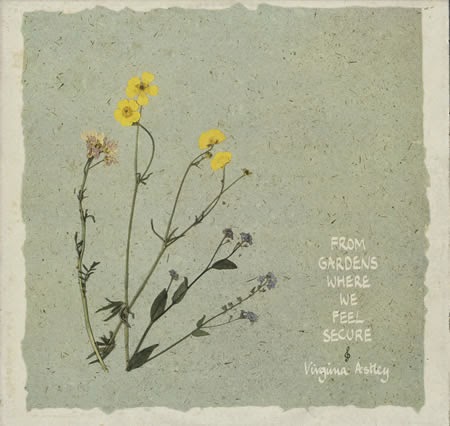
As springtime progresses into summer, one piece of music that I return to is From Gardens Where We Feel Secure, a beguiling piece of classical ambient English pastoral by Virginia Astley. An album containing music which, in Rob Young's words, has a 'timeless, hovering sensation'.*

In fact, the track-listing and sleeve notes alone, reproduced below, deftly prefigure the sounds and ambiance that the record harvests; bringing to mind the elegiac yet beatific Just Another Diamond Day by Vashti Bunyan or John Martyn's Small Hours, the perfect accompaniment to a dreamy spring or summer's day gloaming time in the garden before night falls.


From Gardens Where We Feel Secure

Morning
With My Eyes Wide Open In Dreaming
A Summer Long Since Past
From Gardens Where We Feel Secure
Hiding in the Ha-Ha

Afternoon
Out On The Lawn I Lie In Bed
Too Bright For Peacocks
Summer Of Their Dreams
When The Fields Were On Fire
Its Too Hot To Sleep


Richard Mabey's Nature Cure remains a seminal rumination on our physical and mental relationship with the natural world and his words towards the end of the book seem to strike a chord with our current (albeit temporary) need to seek solace in our immediate surroundings rather than grander and 'wilder' landscapes:

'I began to wonder ... if wilderness was really what I wanted ...what I missed was some common ground between the wilderness and the thoroughly domesticated, some accessible country - real and metaphysical ... I realised that what touched me most was not wilderness as a special, defined place, but the quality of wildness.' 

Hopefully we can all find a little wildness in our own gardens and home surroundings, enough to sustain us through this most strange of springs. Stay safe everyone.  


* If you are looking for some appropriate and stimulating reading whilst sitting in your garden or outdoor space (or anywhere in fact), then Richard King's The Lark Ascending and Electric Eden: Unearthing Britain's Visionary Music by Rob Young will take you away to a good place, and have you searching out new sounds.

Friday, 2 May 2014

'From Gardens Where We Feel Secure'


Music, like landscape, is an endless treasury, with new discoveries patiently awaiting happenstance. One of the blogs that I most look forward to viewing or reading, though I struggle to keep up with its prolific output, is A Year In The Country, which is a particularly rich source of new musical pathways.

Currently on my turntable (how archaic does that phrase now sound), following a recommendation in a post on the aforementioned blog, is From Gardens Where We Feel Secure, a beguiling piece of classical ambient English pastoral by Virigina Astley. As a newcomer to the album, I will not attempt to add to this lovingly crafted description of a "welcome old friend" or the brief mention in the definitive Electric Eden: Unearthing Britain's Visionary Music, in which Rob Young remarks on the "timeless, hovering sensation" of the music contained within it.

In fact, the track-listing and sleeve notes alone, reproduced below, deftly prefigure the sounds and ambiance that the record harvests; bringing to mind the elegiac yet beatific Just Another Diamond Day by Vashti Bunyan or John Martyn's Small Hours, the perfect accompaniment to a dreamy summer's day gloaming.

From Gardens Where We Feel Secure

Morning
With My Eyes Wide Open In Dreaming
A Summer Long Since Past
From Gardens Where We Feel Secure
Hiding in the Ha-Ha

Birds at dawn 5.30 am Sunday 25th April Moulsford Oxfordshire
Churchbells 9.45am Sunday May 2nd South Stoke Oxfordshire
Churchbells and children Sunday morning May 2nd Moulsford
'Lilac' Tuesday morning May 25th Moulsford

Afternoon
Out On The Lawn I Lie In Bed
Too Bright For Peacocks
Summer Of Their Dreams
When The Fields Were On Fire
Its Too Hot To Sleep

Swing gate 2.30pm Sunday 25th April South Stoke
Lambs Sunday afteroon 25th Moulsford Downs
Rowing on the river Sunday afternoon 25th April The Thames Moulsford
Churchbells, children, birds singing late afternoon Sunday 6th June Moulsford
Owl, clock, night noises, Sunday night 16th May Moulsford.


Wednesday, 29 February 2012

In landscape: some thoughts on the best ways to get out there

There are many better ways to experience the landscape than sitting in front of a computer, and here, in no particular order, are some of my personal favourites; no doubt others will have some even better suggestions.


 In the company of children
A walk or adventure in the countryside with young ones helps to bring out the inner child in all of us - camping, poo sticks, building dens, searching for the Gruffulo. My first experience of landscape was through family walks as a kid and roaming around the local area; memories that are still vivid. I hope my children have the same.

Sleeping rough
In recent years I've been on an annual bothy trip with a group of friends, which is a great way to stay out in a remote landscape for a whole weekend, albeit with, at best, a basic level of comfort. Wild camping gives you even more license to find your own spot: in Scotland and Dartmoor you can camp on any uncultivated land and in the rest of the country, as long as you are away from habitations and livestock, just stay overnight and leave nothing behind you will generally be ok. There is plenty of good advice out there on bothies and wild camping.

A bit of danger is good for the soul
Some of the most memorable times I have experienced in the landscape have involved periods of uncertainty and a degree of anxiety: abandoning a mountain bike in a snowstorm and continuing my route on foot, lost and ploughing through thick snow in a whiteout in the Black Mountains; scrambling alone on rocks high up a mountain-side in Tierra Del Fuego to reach a glacier; and clambering along a slippery Striding Edge on Helvellyn unable to stand up due to high winds. Uncomfortable when you are in the middle of it but strangely satisfying when its over and definitely memorable. 

Localism
Getting to know your local landscape is certainly the easiest, and often one of the most satisfying, ways to engage with the environment. The majority of us live in urban areas, which are brim full of green space, woodland, historic buildings, rivers and lakes. No need to dream of that rural idyll, just step out of your front door. In my case, this is the Frome Valley and Oldbury Court in North East Bristol.

Time to study
If you can find a small area of landscape to study intimately - whether focusing on natural history, medieval field systems and settlement patterns or an abandoned industrial site - you can not only contribute in some small way to the body of knowledge and evidence of how the natural and human world work, find surprising things in the most unlikely places but also educate yourself on the world around you.

Conservation volunteering
I've worked as a conservation volunteer a number of times (as well as volunteering on archaeological digs) and I am always conscious that I should do more. Such work enables you to spend a sustained amount of time in the landscape and contribute to something tangible, personally rewarding and of benefit to wider society. BTCV, Wildlife Trusts and the Natural Trust, amongst others, all welcome volunteers.

The sunlit uplands
Any landscape has intrinsic interest but nothing stirs the soul more than getting into the hills and mountains and experiencing the ever changing weather and atmosphere that characterises upland areas; there is something elemental about this - the blood pumps harder, the senses are keener, the rain seems wetter! And there is no finer feeling than sinking a pint in a pub at the end of a long day of fell-walking, whilst your socks slowly dry out.

Using your hands
Without wishing to sound too much like a tree-hugger, a walking stick cut directly from a coppiced hazel tree is one of my favourite possessions. I'm no master-craftsman, as my rustically created bench, wood store, garden path and other efforts testify, but making something by hand using wood, stone or other natural materials links us both to our more highly-skilled and resourceful forebears and our environment in a way that many aspects of modern life shy away from or discourage. 

Festival in the sun
This is a bit of a boom time for music festivals 'out in the country' of all shapes and sizes. Whilst there is often a focus on mud and the temperamental British summer weather, drinking with friends round the camp fire and sitting in the sun listening to great music are the more common experiences - what could be better? My own personal favourites are the Green Man Festival and the End of the Road Festival, and everyone should try good old Glastonbury at least once. Or why not organise your own mini festival.

Taking it to the extreme
An adrenalin-junkie approach to the great outdoors can be tiresome and even indicate a lack of empathy with the natural rhythms of the landscape. However, reinvigorating yourself with a spot of coasteering, gorge-walking, white water rafting or mountain-biking from time to time is good for the soul. Ideally, keeping it simple without the need for expensive gear, gadgets or over-the-top lists of safety rules.

Night walking
For reasons I wont bore you with I once set off on a 15 mile circular walk around the North London/ Hertfordshire fringes late at night. It was cold and a bit eerie in parts but I was fortified by beer, had a few sleeps on the way and enjoyed the different perspective on familiar places. If its good enough for Charles Dickens, its good enough for me.

Step into the garden  
Gardens can easily be overlooked in favour of flashier landscapes. Building a pond, planting trees and generally encouraging wildlife in my modest city garden has given me as much pleasure as any of the other activities listed here. What can beat seeing frog-spawn magically appear in a pond in early Spring, a blossoming cherry tree or hearing chicks in a bird box?

Or why not just sit under a tree reading or dozing, relax, let all your senses take in the landscape around you and forget about the time...