Monday, 29 July 2013

Voices from the well

The Church of Merthyr Issui at Patricio (now Partrishow) inhabits its location high up on the western slope of the Grwyne Fawr valley in the Black Mountains as only an ancient country church can do; nestled stone, standing in calm defiance of time. Seeking shade on a day of broiling heat, the dank emptiness inside was a welcome pause from the summer uniformity of the past few weeks. Looking up and around, the glory of the archaic architecture and iconography met my gaze; a spiritual, though - for this heathen - not a religious, leap back into the Middle Ages.

The church has occupied this site since at least the eleventh century and is named for a Christian hermit, Issui, who lived in a cell in the dingle below, next to the fast flow of Nant Mair ('St Mary's stream') and a Holy Well that probably predates the church as a place of worship and pilgrimage. Springs and wells have a deep topographical relationship with places of worship: as Richard Morris points out, 'the basic meaning of the Old English wylla is spring. More than any other type of feature waeterwyllas span the transition from pagan to Christian geography'. Issui was murdered by a passing traveller who had taken rest in his cell (hence Merythr, 'martyr') and this ungrateful act led to the foundation of a church in his name; in the more florid words of P. Thoresby Jones in his 1938 Batsford guide '...to commemorate an unwholesome and officious hermit who rashly rebuked some lusty pagan prince'. 


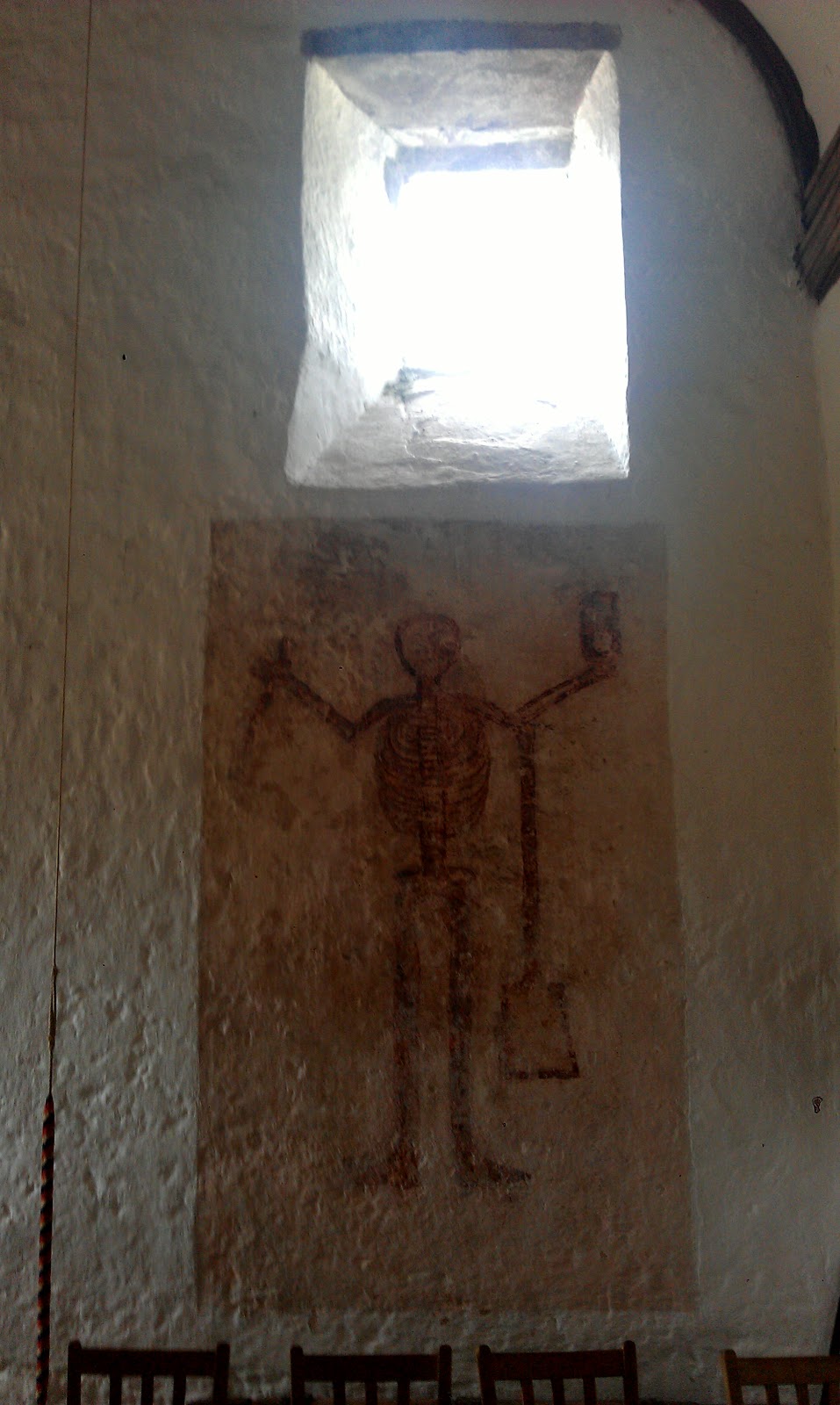
For once my interest was focused on the interior of the building rather than the landscape setting. Likely due to its remote location, the church did not suffer the same state-sanctioned vandalism as most during the Reformation and therefore retains much of its late medieval features and ambiance (P Thoresby Jones again: 'the Puritan iconoclasts failed to find it'). From my last visit I had remembered the 'doom' mural on the west wall of the Nave: the figure of 'Time' represented by a skeleton holding a scythe, hourglass and spade; presumably a subtle reminder to the parishioners as they left the service that this earthly life, and therefore time to repent for their sins, is limited. As shafts of sunlight streamed through the window above, the outstretched arms of the looming figure seemed to widen; rib bones and skull standing out in sharp relief to the white washed wall.


The church also retains a rare surviving rood loft, or gallery, and screen; its intricately crafted carvings, including a dragon - representing evil - consuming a vine - representing good, a common motif in the Welsh Marches. As is so often the case, the name of the highly skilled artisan who has left us this everyday masterpiece will never be known; was it the work of a local craftsman or imported skilled labour from Italy or Flanders?

I will choose less sultry weather for my next visit and explore the wider landscape surrounding the church further: the aforementioned Holy Well in the dell below, decorated with niches which once held sacred images and relics; the nearby stone bearing an incised Maltese Cross used as a waymarker for pilgrims; and the ancient bridge across the river Grwyne known as Pont Esgob (the 'Bishop's Bridge'), over which Archbishop Baldwin is said to have travelled on his way to preach at the church in 1188, on a tour of Wales to gather support for the Third Crusade (as recorded in Giraldus Cambrensis' famous Journey Through Wales).

Edward Thomas, an Anglo-Welsh son of such a landscape, captures the elegaic sense of a place seemingly now left adrift from its history in his poem The Mountain Chapel:

'Chapel and gravestone old and few
Are shrounded by a mountain fold
From sound and view
Of life. The loss of the brook's voice
Falls like a shadow. All they hear is the eternal noise
Of wind whistling in grass more shrill...
...Under the sun. When gods were young
This wind was old.'

So much to learn from the temporal repository of compelling lives and deeds behind the decoy of sleepy backwaterness; 'voices from the well'.


References

Baker, Kenneth (Ed.), 2000. The Faber Book of Landscape Poetry. London: Faber.

Gerald of Wales (trans. Thorpe, Lewis), 1978. The Journey Through Wales/ The Description of Wales. London: Penguin.

Mason, Edmund, 1975. Portrait of the Brecon Beacons. London: Robert Hale.

Morris, Richard, 1989. Churches in the Landscape. London: Dent.

Reed, Canon Arthur, 2010 .The Church of Merthyr Issui at Patricio. Leaflet.

Thoresby Jones, P, 1938. Welsh Border Country. London: Batsford.

Monday, 22 July 2013

Relief from the Heat of Noon


The summer rolls on remorselessly, harsh heat overcoming wasted shade; at such times reading becomes a relief from the unwavering sun, especially lines that reflect the season: midsummer leaching from the page. Here's a glimmer of John Clare, each word offering some cool respite. 


There lies a sultry lusciousness around

The far-stretched pomp of summer which the eye

Views with a dazzled gaze - and gladly bounds

Its propects to some pastoral spots that lie

Nestling among the hedge, confining grounds

Where in some nook the haystacks newly made

Scents the smooth level meadow-land around

Whilst underneath the woodland's hazley hedge

The crowding oxen make their swaily beds

And in the dry dyke thronged with rush and sedge

The restless sheep rush in to hide their heads

From the unlost and ever haunting flie

And under every tree's projecting shade

Places as battered as the road is made


The Heat of Noon


Tuesday, 2 July 2013

Unbounded freedom ruled the wandering scene

"I thought of walks in the English countryside, where people start shouting at you as soon as you stray from the footpath".  

A statement by George Monbiot from his thought-provoking new work Feral that, like the book as a whole and the concept - rewilding - that it advocates, both resonates and slightly infuriates at the same time. 

'Rewilding' is certainly trending in environmental circles at the moment. However, its not so much the prospect of the return of the wolf, lynx, beaver and other predators and large herbivores to the uplands and wilder parts of the British Isles and Europe that is in my thoughts (though I do have some practical and intellectual problems with this idea that may be explored at another time). The above quote struck a chord with me because it also hints at a more basic, anthropocene concern when considering the future of landscapes and ecosystems; namely, perhaps before we rush headlong into facilitating the theoretical 're-introduction' of the straight-tusked elephant that roamed European forests and plains 40,000 years ago, we should address the more fundamental concern of land ownership, access and control. 

To be fair to Monbiot, rewilding is a useful and imaginative stalking horse for stimulating debate on this issue and future direction in the wider policy fields of agriculture, conservation, energy, housing, transport and land-use. My own ruminations on the bizarre situation that we in these islands find ourselves - an increasing population, in many ways more autonomous than ever before, excluded from living and working (or even visiting) the larger part of the land mass on which we dwell - have cooked up a righteous soup of thoughts around community food production, noble, peaceful trespass and the hidden history of the tyranny of enclosure. How can it be right that '...nearly half the country is owned by 40,000 land millionaires, or 0.06 per cent of the population, while most of us spend half our working lives paying off the debt on a patch of land barely large enough to accommodate a dwelling and a washing line' (Simon Fairlie)?

A number of recent readings and 'Twitter-leads' have helped to stimulate this well-spring. The most striking being Gerry Conley's blog post on The right to roam land and shore, 'but for the sky, no fences facing'which eruditely brings together many of the touch-stones of this subject: Norman land grabbing, eighteenth and nineteenth century Parliamentary Inclosure, John Clare, the Diggers of St George's Hill, the Kinder Scout Mass Trespass, Marion Shoard, Right to Roam legislation, corporate land ownership and the creeping privatisation of public space. These themes have also been essayed in articles by Peter Lazenby and, again, George Monbiot. 

The Diggers, a radical group of proto-socialists who occupied St George's Hill in Surrey in 1649 are fascinatingly chronicled in the 1975 film, Winstanley. In many ways, this doomed five month attempt to establish the concept of the 'Common Treasury' of the land for all, ruthlessly quashed by the reassertion of the primacy of private capital and ownership, occured during a pivotal period in history for the English landscape and society; a course was being set for the processes of enclosure and 'improvement' of the land, of successive agricultural, industrial and post-industrial revolutions that sculptured the environments and socio-economic realities of subsequent generations, and still resonate today: 'Winstanley had a dream of a wonderful, gentler, more just and happy world; a dream that came again to other people in succeeding centuries, but for whose realisation we are still waiting' (David Gardiner).  

The arc of this story is well rehearsed, and well written, ground that I am not going to retread. Instead, I am leaving the path, plunging into the undergrowth; exploring the concepts of access, private ownership and enclosure, and maybe rewilding of the self, head on and with the 'muddy boots' of empiricism. Taking, in Richard Mabey's words, '...the opportunity to experience it (nature) face to face, with its qualities of wildness and renewal intact'. So, rather than using an Ordnance Survey map to pleasingly link up the anarchic network of dashed lines indicating public rights of way, hill tracks and unmetalled lanes, I have devised a mildly subversive circuit through hill and dale that studiously avoids legally prescribed routeways: a Trespass Way. 

Monday, 1 July 2013

Reliquiae Volume One


Reliquiæ is an annual journal of poetry, short fiction, non-fiction, translations and visual art, edited by Autumn Richardson & Richard Skelton. Each issue collects together both old and new work from a diverse range of writers and artists with common interests spanning landscape, ecology, folklore, esoteric philosophy and animism.
Full print contents:

Two strange tales from Mark Valentine, including a new work, "For She Will Have Her Harvest", about the graveyard poet Henry Kirke White. Noor de Winter on birch trees, music and the "artist-as-listener" in the work of of German expressionist writer and instrument-builder, Hans Henny Jahnn. Two poem sequences by Richard Harms - "Salt", an 18th-century sea-voyage in five parts; and "Wing", a naturalist's minutely observed depictions of Australian bird-life. Autumn Richardson's translations of a quartet of Inuit songs collected by Danish explorer Knud Rasmussen. John Hutchinson on the "imaginal world" of Sufi mysticism. Richard Skelton's elegy for the now-extinct grey fell fox. Mark Brennan's oil paintings of the Canadian wilderness. 

In addition to these there are Knud Rasmussen's account of Simigaq, an Inuit woman from Greenland, and the songs she shared with him; a Finnish legend from R. Eivind; Richard Jefferies on the miracle of hawks gliding; Wazha'zhe & Meskwaki myths; poetry by Francis Ledwidge; a selection of Manx folktales from Sophia Morrison; poetry by Christina Georgina Rossetti; a Greenlandic Inuit creation myth and two stories from W.B. Yeats.


Further information at: http://www.corbelstonepress.com/reliquiae-1.htm

Sunday, 16 June 2013

'I see a new earth': Herzog v Machen


Opening scene of Heart of Glass; directed by Werner Herzog, soundtrack by Popol Vuh, 1976

'After years of labour, after years of toiling and groping in the dark, after days and nights of disappointment and sometimes of despair, in which I used now and then to tremble and grow cold with the thought that perhaps there were others seeking for what I sought, at last, after so long, a pang of sudden joy thrilled my soul, and I knew the long journey was at an end. By what seemed then and still seems a chance, the suggestion of a moment's idle thought followed up upon familiar lines and paths that I had tracked a hundred times already, the great truth burst upon me, and I saw, mapped out in lines of sight, a whole world, a sphere unknown; continents and islands, and great oceans in which no ship has sailed (to my belief) since a Man first lifted up his eyes and beheld the sun, and the stars of heaven, and the quiet earth beneath'.

The Great God Pan; written by Arthur Machen, 1894  

Tuesday, 28 May 2013

Monday, 27 May 2013

'Yon pure waters, from their aery heights'

Mountain pool, Offa's Dyke footpath, Hatterrall ridge - Black Mountains

"When hope presented some far-distant good,
That seemed from heaven descending, like the flood
Of yon pure waters, from their aery height"

Tributary Stream, William Wordsworth (Poems of Wordsworth, Oxford University Press, 1919)

Wednesday, 15 May 2013

The beautiful game lives on in Ultima Thule


 I'm very much an ex football fan, jaded and disillusioned by the ridiculous grandiloquence of the professional game.

However, in remotest Ultima Thule, it seems there is a true venue for the beautiful game.

This is the home ground of IB Vestmannaeyja, a football team based on the island of Heimaey off the south coast of Iceland. Photograph from http://groundhopping.se

Tuesday, 23 April 2013

Landscape in particular 6: Harberton, Devon and Tierra del Fuego

Several years ago my partner Lisa and I spent a month criss-crossing the towering wonder of the Andes of Chile and Argentina; a Patagonian odyssey of the sublime and the superlative. In the midst of all this epic-ness my memory reserves a special place for an altogether more temperate landscape, that of Harberton in Argentinian Tierra del Fuego. This tiny settlement and gentle farm-scape occupies a narrow peninsula that nudges into the cold, wind-whipped Beagle Channel; a plain-speaking and modest interloper amidst the drama of the world's southern-most settled terrain. Head south and Cape Horn and Antarctica await.

Harberton is the oldest estancia (rural estate or ranch) in Tierra del Fuego, established as a sheep farm by an English misionary from Bristol, Thomas Bridges, in 1886. This was a period when the vast lands of Patagonia were opened up to sheep farmers from England and Scotland to become, for a time, one of the largest wool producing regions in the world. The settlement is named after the Devon home village of Bridges wife Mary ('Farmstead on the river Harbourne', an Old English river name meaning 'pleasant stream'). The distinctive white corrugated iron, red roofed farmstead that still stands today was prefabricated by Mary's father in England, shipped over and assembled at a sheltered spot chosen by indigenous Indians of the local Yamana tribe. With an empathy unusual for the time, Bridges devoted the last 30 years of his life to living amongst the Yamana people and compiling a dictionary of their language, with a sideline in rescuing shipwreck survivors, and was granted the land at Harberton by President Roca in recognition of his work.

Intrigued by the guidebook description, we took a bus trip from the provisional capital of Ushuaia; a tedious and interminable drive on a poorly maintained side road from the main highway. Released from the stuffiness of the bus we found ourselves, after weeks of Andean terra incognita, in a strangely familiar place. Bruce Chatwin also visited, and described this discovery of the known in his classic In Patagonia

"Coming into Harberton from the land side, you could mistake it for a big estate in the Scottish Highlands, with its steep fences, sturdy gates and peat-brown trout streams. The Rev Thomas Bridge's settlement was strung out along the west shore of Harberton Inlet, shielded from the gales by a low hill ... The house, imported long ago from England, was of corrugated iron, painted white, with green windows and a soft red roof ... The flowers of an English garden seemed to glow with an inner brilliance. A path led through a wicket gate arched with a whale jaw. Woodsmoke drifted over the black water, on the far shore, geese were calling."


 And this is exactly the scene that we found. A serene piece of England transported to the far end of the earth; a National Trust tea room would not have been out of place amongst the well kept shrubs and cottage garden borders. South America seems to specialise in this type of liminality; isolated remnants of transplanted northern European material and psychological culture incorporated into the predominant and home-grown Latin American hegemony: German style houses throughout rural Chile; Welsh enclaves in Patagonia; English country clubs and polo in the prosperous hinterlands of Buenos Aires; the Falklands, a Hebridean outlier garrisoned by red, white and blue.

Approaching the farmhouse we observed a tall, slim man, white haired and bearded, in denim dungarees. Visually he was as familiar as the English buildings and landscape around him, but he was in conversation in the easy Spanish of a native speaker. This I took to be Thomas Goodall, the great grandson of the founder of the farm, who still works the land today. In his cultural history of Patagonia, and spefically in relation to the old sheep rearing areas, Chris Moss observes that "Englishness has been preserved in people's faces, and in surnames". We then spent several slow hours wandering the lush greeness of the peninsula, the land meshed together by sheep folds and enclosures of wood and stone, accompanied by a warming breeze and ever-present bird song. The distant views seawards and southwards to the harsh mountains of Chile's Isla Navarino seemed, and not just administratively, to occupy another country; sentinals of malevolence biding their time, like circling behemoths.


 Thomas Bridge's son, Lucas, 'went native' amongst the Yamana and used Harberton as a refuge for the dwindling numbers of indigenous speakers during the aggressive colonialism of late nineteenth and early twentieth century Argentina. He wrote a thrillingly titled memoir Uttermost Part of the Earth (1947) that I would love to find a copy of; perhaps to read on a visit to the soft green hills of Harberton, south of Totnes in deep England, busy and prosperous in the fifteenth century but now a quiet backwater, and be transported again to this facsimile dreamscape in the 'land of fire', 8,000 miles distant.

 This is the latest in a regular-occasional series of posts on specific landscapes and places that are particularly meaningful to me, for whatever reason; after all, interest in the topographical is nothing without a feeling for sense of place: genius loci.

Previous 'Landscape in particular' posts:

References

Blacksell, Sophie (Ed.), 2005 Footprint Patagonia Bath: Footprint.

Chatwin, Bruce, 2005 In Patagonia London: Vintage.

Hoskins, W.G., 1971 Old Devon London: Pan Books.

Mills, A.D., 1995 A Dictionary of English Place-names Oxford: Oxford University Press.

Moss, Chris, 2008 Patagonia: A Cultural History Oxford: Signal.


Monday, 8 April 2013

The landscape that Thatcherism created


"Where there is harmony, may we bring discord. Where there is truth, may we bring error. Where there is faith, may we bring doubt. And where there is hope, may we bring despair."

"I see no joy, I see only sorrow; I see no chance of your bright new tomorrow; so stand down Margaret, stand down please, stand down Margaret".