>>> landscape / topography / sense of place <<<
Navigating the interface between landscape history & deep topography;
& other paths ...
Showing posts with label landscape writing. Show all posts
Thursday, 4 January 2018
Pathways through long winter days until bright Phoebus shines down again
A quick ramble here through an assemblage of mid-winter cultural highlights. If record shops are a species indicator of a civilised polis (which they surely are), then it was good to have affirmation that the force remains strong in Bristol with the opening of a new Rough Trade store. A first wander around the racks yielded Bright Pheobus, songs by Lal and Mike Waterson, newly re-released on vinyl. Its 'lost folk-rock classic' story is unfurled in sleeve notes by Pete Paphides largely replicated in a Radio 4 documentary. Featuring Richard Thompson, Ashley Hutchings and a seemingly endless cast of early 70s electric folk, Bright Pheobus has joined the ever-replenished cast of misunderstood or under-marketed records of the time which have resurfaced, championed anew. A highlight for me is the track, Child Among the Weeds, featuring Lal Waterson and Bob Davenport's extraordinary, unrestrained vocals.
The post-war folk music revival is not covered by Steve Roud's magisterial (i.e. dauntingly massive) Folk Song In England, but I will try and persevere with this sweeping history of, well folk song in England. A chapter on sea shanties is included, a sound brought to vivid life by a communal sing-along with Halifax's finest renderers of whaling song, Kimber's Men, upstairs at The Greenbank, Easton in November. Other reading matter on 'the book pile' comes in the form of the multitude of pagan arcania found within the pages of Folk Horror Revival: Field Studies and the no-less fascinating A Natural History of the Hedgerow by John Wright. The 'folk horror' label perhaps encompasses Ben Myers The Gallows Pole, which I enthusiastically reviewed earlier in the year and remains a favourite recent fiction read.
Elsewhere on BBC radio, The Drover's Path fitted the bill as a suitably wintry Christmas Eve ghost story, Nick Luscombe presented Radio 3's Late Junction's favourite albums of 2017 and there was a gripping dramatisation of Neil Gaiman's refreshingly non-standard fantasy Anansi Boys, starring Jacob Anderson, Grey Worm from Game of Thrones; a Season Six box set of which was my Christmas guilty pleasure. Robert Macfarlane's #TheDarkIsRising Twitter-athon led to another gem from the BBC radio archive, a 1997 adaptation of Susan Cooper's midwinter classic chronicling a duel between the Dark and the Light across snowy Sussex downland. The ubiquitous (in a good way) Mr Macfarlane also brought forth his importantly beautiful collaborative work with artist Jackie Morris, The Lost Words; if ever there was an example of a Christmas present bought for your child that would give as much pleasure to the giver as the receiver, then this was it.
Fly bird fly on your raven wings
Take to the sky and sing for the love of wheeling and turning
These words, images and songs spun around my head as a post-Christmas walk around YGrib, Waun Fach and Pen Trumau in the post-snow, but still frozen, western Black Mountains literally blew the cobwebs away; awaiting the days when bright Phoebus will shine down again.
Sunday, 23 July 2017
Ben Myers - The Gallows Pole: Once upon a time in the West Riding
The arresting cover of Ben Myers'
sixth novel is a statement of intent for the work inside: historical fiction
with danger and harshness and radicalism foregrounded; a bit punk rock, a bit
psychedelic, not too knowingly retro. Frankly, I'd have bought it for the
cover artwork alone. Thankfully, this is an author with form and the story itself does not
disappoint; it cracks along at pace, based on a little-known episode in
history tailor-made for the strain of gritty rural-noir which
Myers, Paul Kingsnorth, Cynan Jones, Ross Raisin and others have rendered in
recent years. The unearthed source material merits such a telling. It's the
1760s and the wild West Riding of Yorkshire is on the cusp of transformation,
careless of the coming pandemonium to be wrought by industrialised
manufacturing. Amidst the self-reliant weaving communities of the Calder
Valley - for William Atkins (The
Moor) 'a
ditch made dim by its narrowness', a place of fugitives - emerge the Cragg
Vale Coiners. Led by the brutally charismatic 'King' David Hartley, their
outlaw business is the clipping of coins to produce counterfeit money; local
currency for local people, recycled coin outwith the control of not only the
crown, government and taxation but also the new capitalists ready to harness
and exploit the power of land and labour. Thus, a dangerous business and
(literally) a capital offence.
The book's stylistic and narrative similarities with Kingsnorth's The Wake are striking. Both have central characters - David Hartley and Buccmaster - who are deluded, self-mythologising and ruthless yet also cast with a certain 'Man With no Name' dark allure. Like mythical cowboys of the northern past, these doomed men raging against the dying of the light are also possessed of pagan visions of stagmen and the old gods. Both authors utilise blunt vernacular speech to give voice to their protagonists, albeit in Kingsnorth's case a 'shadow tongue' version of Old English is utilised for the whole narration.
In the opening chapters, we see how up and over from the surrounding valleys
men come to King David's call, 'like crows to the first pickings of carrion
after the snow melt'; a repetitive roll-call of locally entrenched surnames:
Dewhurst, Clayton, Sutcliffe, Bolton, Hepworth, Eastwood, Bentley, Hoyle,
Pickles, Sykes, Greenwood, Feather and Proctor. These everyday monikers later
counter-pointed by the tally of Yorkshire nobility called from across the
ridings to address the threat to their wealth and power presented by the
coiners activity. We dig repetition, as Mark E Smith would have it, and so
does Ben Myers. It's a technique used deliberately and effectively throughout,
toughening the narrative: 'the moors are ours and the woods are ours he
said. And the marshes are ours and the sky is ours and the fire is ours and the
forge is ours. The might is ours and the means are ours and the moulds are ours
and the metal is ours and the coins are ours and the crags are ours and this
grand life in the dark wet world is ours.'
Hartley's
lair is high amongst 'the hill's hanging silence', to use Ted Hughes'
description of this haunted terrain of his youth, where bosky slope gives way
to moorland waste. A hint of Cormac McCarthy pervades the depicted harsh
beauty of this landscape. When Hartley's nemesis, excise-man William
Deighton - a walker of the moors and valleys in pursuit of those who would evade
the (real) king's tax - returns to Halifax in the gloaming, the town's
lights flicker 'as if the sky had fallen in defeat, and draped itself across
the rise and fall of the bloodless, smothering land.' To my mind what elevates Myers prose above much similar
place-bound company is the clear rootedness of the writing in the Calderdale-based author's
embodied knowledge - based on walking and observing - of the landscape in which
the actors operate, buttressed by an authentic portrayal of the
life-rhythms of those working the land. This is an author unafraid to leaven
the drama of the story with the small detail of rural life: for instance, a
couple of pages describing a scything team working their field at pace 'as they
raced against the season and the coming of the harvest moon.'
A certain poetic mysticism is also scattered amidst the thrifty speech of Hartley and the Coiners, somewhat at odds with their rough ways: 'rope or rain or a day threshing grain ... I take each as it comes'; 'the moor is the moor and the wind always blows.' Thugs ain't what they used to be, perhaps. Silver-tongued maybe, but there are frequent brutish scenes of rising and implied violence, recalling prime-Scorsese or, closer to home, Shane Meadow's Derbyshire-set Dead Man's Shoes in their cinematic menace and liberal deployment of the harshest word in the English language, not quaint. The shocking end of loud-mouth drunk Abraham Ingham thrust head-first into an open fire, 'left smoldering, a spent match in human form' as his killers return to their tap-room pints, is particularly wince-inducing. As is the defilement of the traitor James Broadbent in York gaol. A gruesome end seems to be a possibility for just about everyone involved.
This violence, combined with the radical social commentary of the story and pervasive sense of movement through the landscape, bestow filmic qualities which the author acknowledges as he describes an eclectic playlist put together whilst writing the book. It's not hard to hear this music soundtracking a film adaptation of the book, which might look a little like a mash-up between Ben Wheatley's A Field in England, Ken Loach's Black Jack and Stanley Kubrick's Barry Lydon.
As the place-names in the narrative came thick and fast - reminiscent of a seventeenth-century survey of manorial bounds - I pulled out my battered Ordnance Survey map of the South Pennines, weathered by time, held together by yellowing sellotape. Family connections bond me to the country immediately north of Calderdale, Keighley and the Worth Valley over Cock Hill and Nab Hill, and I have previously posted about this landscape, my younger self's introduction to hill walking, now embedded in memory. The names on the map speak of place as, above all, morphology and topography. Northern - mostly Anglo-Saxon or Norse - descriptors of the lie of the land. Clough, slack, holme, delf, edge, nook, wham, carr, hey, hole, head, nab, bank, dyke, shaw, royd, shelf, stones. A lexicon used by Myers to rivet the narrative to its locale; to particularise the valleys and streams and rocky places and moors and woods in which the story unfolds. Many of these toponyms have been appropriated as local surnames, fixing a symbiosis between people and place; the bearers literally a product of their landscape. And there, above the river Ryburn feeding into the main Calder Valley, a crow's fly over Crow Hill from the Hartley homestead in Cragg Vale, spreads Gallows Pole Hill. Presumably, part-inspiration for the book's title (alongside the traditional song, The Maid Freed From the Gallis Pole)?
A certain poetic mysticism is also scattered amidst the thrifty speech of Hartley and the Coiners, somewhat at odds with their rough ways: 'rope or rain or a day threshing grain ... I take each as it comes'; 'the moor is the moor and the wind always blows.' Thugs ain't what they used to be, perhaps. Silver-tongued maybe, but there are frequent brutish scenes of rising and implied violence, recalling prime-Scorsese or, closer to home, Shane Meadow's Derbyshire-set Dead Man's Shoes in their cinematic menace and liberal deployment of the harshest word in the English language, not quaint. The shocking end of loud-mouth drunk Abraham Ingham thrust head-first into an open fire, 'left smoldering, a spent match in human form' as his killers return to their tap-room pints, is particularly wince-inducing. As is the defilement of the traitor James Broadbent in York gaol. A gruesome end seems to be a possibility for just about everyone involved.
This violence, combined with the radical social commentary of the story and pervasive sense of movement through the landscape, bestow filmic qualities which the author acknowledges as he describes an eclectic playlist put together whilst writing the book. It's not hard to hear this music soundtracking a film adaptation of the book, which might look a little like a mash-up between Ben Wheatley's A Field in England, Ken Loach's Black Jack and Stanley Kubrick's Barry Lydon.
As the place-names in the narrative came thick and fast - reminiscent of a seventeenth-century survey of manorial bounds - I pulled out my battered Ordnance Survey map of the South Pennines, weathered by time, held together by yellowing sellotape. Family connections bond me to the country immediately north of Calderdale, Keighley and the Worth Valley over Cock Hill and Nab Hill, and I have previously posted about this landscape, my younger self's introduction to hill walking, now embedded in memory. The names on the map speak of place as, above all, morphology and topography. Northern - mostly Anglo-Saxon or Norse - descriptors of the lie of the land. Clough, slack, holme, delf, edge, nook, wham, carr, hey, hole, head, nab, bank, dyke, shaw, royd, shelf, stones. A lexicon used by Myers to rivet the narrative to its locale; to particularise the valleys and streams and rocky places and moors and woods in which the story unfolds. Many of these toponyms have been appropriated as local surnames, fixing a symbiosis between people and place; the bearers literally a product of their landscape. And there, above the river Ryburn feeding into the main Calder Valley, a crow's fly over Crow Hill from the Hartley homestead in Cragg Vale, spreads Gallows Pole Hill. Presumably, part-inspiration for the book's title (alongside the traditional song, The Maid Freed From the Gallis Pole)?
One minor place-naming misstep is the use of Calderdale and West Yorkshire, modern-day administrative units which would not be used as descriptors of the local area by eighteenth-century folk. Not sure either about the use of the archaic 'Yorvikshire' in
Hartley's vernacular, but artistic license at play here so fair enough. Of
course, it is the storyteller's prerogative to extrapolate the partial facts
that are fed down through history but this reader also wonders whether King David
really was as locally revered and acclaimed as suggested. How many really
were thankful to Hartley for clothing and feeding them, and giving them hope?
Did thousands really line the old streets of York to view his procession to the
gallows?
Not in dispute are the economic changes which circle around and loom over the actions of the Coiners (the 'progress' of proto-capitalism, industrial development, a hardening of the rule of law and land ownership), prefiguring the enormous rupture in the way of life of the independent dwellers of these previously left-alone valleys that the Industrial Revolution would bring. Earlier in the eighteenth-century Daniel Defoe had commented approvingly on the lack of dependence on and subservience to the gentry amongst the self-sufficient and egalitarian populations of the farmsteads and hamlets of these hilly districts of the West Riding. As the century draws to a close the characters here are lamenting not only that 'the machines and mills are coming' but also 'they do not give a fuck about us hill-dwellers'; 'the land is being sold off. They say there are mills the size of cathedrals in Lancashire.' The self-made prosperity of the cottage industry of small-holdings and hand-looms is coming to an end. A few decades later Halifax and the Calder Valley would be central to a more famous popular uprising, the revolt of the Luddites; a conflict which Robert Reid in Land of Lost Content described as threatening 'the stability of the nation from within as it had never been threatened since.'
In
the end, and in the face of this maelstrom, we leave Hartley dreaming of his moor and woods, and the Stagman: 'still he waches now and so too will be there when im drug up to that gallis
pole that awaytes us Heel be thur I no it Waytin a me.' In reality, as the epilogue
hammers home, 'the stone cathedrals of mass production' were to win out and
King David would be forgotten. Mills and new rows of terraced houses, and turnpike roads, canals and railways, would remorselessly fill the valleys, transforming not only the population's
economic and social lives but also the very landscape. The Coiners and their
descendents would ultimately bend to the will of the new puritans of capital,
commerce and mass-production.
Friday, 13 January 2017
PhD Research Paper #4: A diversity of words and images - topographers and antiquarians, artists and writers at Llanthony and the Vale of Ewyas
From time to time I will post 'bite size' chunks of the material I am preparing for my PhD thesis: works in progress, but content which I feel may be of interest to a wider audience. All will be very much draft versions, not necessarily - probably not - reflecting the final wording that will eventually appear in the Thesis. In-text references are included but a full bibliography is not. This paper is based on a section of the case study on Llanthony Priory in the Black Mountains, Monmouthshire.


‘Llanthony Abbey’ by David Cox, 1838.
Written references to Llanthony and the Vale of Ewyas in the post-medieval and early modern period are sparse; even topographical writers of the time did not usually specifically refer to the wider landscape (Lancaster 2008, 11). John Leland made very brief mention in his 1540 Itinerary (in a paragraph on Llanthony Secunda): ‘Nant Honddye (Llanthonddye – Llan nant Hondy) a priori of blake charms … this priori was fair, and stoode betwixt ii great hills’ (Chandler 1993, 176; Roberts 1846, 233). Michael Drayton’s epic topographical poem of 1612, Polyolbion, included a verse on the valley which begins: ‘Mongst Hatterills loftie hills, that with the clouds are crowne’d, the valley Ewias lies, immers’d so deep and round …’ (Drayton 2001).
It was
as new tastes for the ‘sublime’ and ‘picturesque’ in landscapes and places of
history, particularly in wild and remote setting, began to take hold in the
later eighteenth century that the priory became a subject of particular interest. Uvedale Price, author of the influential treatise Essays on the Picturesque, as Compared With the Sublime and the Beautiful of 1794 owned Foxley, one of the priory’s Herefordshire estates, where he created a landscaped park in line with his views on the picturesque (Pavard 2016, 80). William Gilpin (2005, 52)
visited Llanthony during his influential tour of the Wye and South Wales in
1770 and observed:
‘Dugdale
describes it, in his Monasticon, as a
scene richly adorned with wood. But Dugdale lived a century ago: which is a
term that will produce or destroy the finest scenery. It has had the latter
effect here, for the woods about Llanthony Priory are now totally destroyed;
and the ruin is wholly naked and desolate.’
A somewhat bleak scene which pre-dated poet-squire Walter Savage Landor’s
major tree-planting programme during his brief but colourful period of lordship of Llanthony (discussed in detail in a future post). In the wake of Gilpin and the Romantics that
followed, Llanthony, like other medieval monasteries in dramatic locations,
received a steady stream of visitors who were inspired to record their
reactions to the place. Indeed there is a vast and diverse corpus of images and
words centred on the priory ruins and the surrounding landscape.
Henry Penruddocke
Wyndham, a Fellow of the Society of Antiquaries, toured Wales in the 1770s and
produced the first published account of a tour which included Llanthony (Buck
2016, 6). Architects and
antiquarians such as Joseph Parker and Richard Colt Hoare were also regular
visitors, studying and recording the ruins in a more analytical and scholarly way
(Gibbs 2016b). Colt Hoare, who later witnessed the windows of the western
frontage collapsing, visited with Archdeacon Coxe whose poor impression of the
state of the roads as he journeyed through the valley has already been quoted.
To him the priory ruins derived ‘a particular beauty from their situation in
the Vale of Ewias, which unites dreariness and fertility, and is well adapted
to monastic solitude’, though he bemoaned their ‘hastening to decay’ (Coxe
1801, 212). Other early nineteenth century visitors were wont to provide more dramatic
and exaggerated descriptions of the topography they encountered. Commentating
on the Honddu John Beaumont (1803, 314-5) exclaims ‘at an immense depth beneath
(the road) the torrent is seen raging’, whilst the hamlet of Cwmyoy was
‘fearfully hanging on a cliff, and beneath a menacing hill.’
‘Llanthony Abbey, Cwmyoy, Monmouthshire’ by JMW Turner, 1794 (Source:
Tate Museum, www.tate.org.uk).
The late eighteenth and
nineteenth century saw a proliferation of paintings and engravings of the
priory and its environs. Whilst the wider landscape setting is often somewhat
impressionistic, with the hillsides particularly exaggerated, such images not
only confirm Llanthony as a key subject within the proliferation of landscape
art but also provide some interesting topographical detail. One of the most
famous images is by JMW Turner, a prolific chronicler of the
historic monuments of the day. His view of the priory (which may have helped to
proliferate the use of ‘Abbey’ rather than priory as an appellation) shows the
surrounding hills higher and more precipitous than in reality, with a similarly
romanticised river scene in the foreground and the priory flooded with
‘heavenly light’ (Sinclair 2001, 142). Commenting on the showing of the painting as part of the Tate Museum Ruin Lust exhibition (March 2014), Iain Sinclair described it as ‘fraudulent’ in its interpretation of the hills and the ‘cataracts’ of the river; an image made for the tourist, the equivalent of modern ‘ruin porn’ (Radio 4 Front Row, 03/03/14). Interestingly, also
clearly represented is the still now extant curvilinear enclosure on Loxidge
Tump above the ruins, which may originate as a medieval sheep corral operated
by the priory as discussed in the previous chapter.
‘Llanthony Abbey’ by Virtue, date unknown.
Although
it is rare for such images to focus on anything but the priory ruins
themselves, it is interesting to study the landscape backdrop. Often quite
generic but sometimes able to illustrate something of the landscape of the time.
In Virtue’s painting the enclosed pasture, mountain wall and the nant farmstead of Troed-rhiw-mon can
clearly be seen on the opposite side of the valley. A more open,
neatly hedged fieldscape is observed in Edward Hayes’ picture of 1800, whilst the priory is often very much part of an agricultural scene with
sheep and cattle grazing around the ruins.
‘Llanthony Abbey’ by Edward Dayes, 1800 (Source: National Library of
Wales, https://www.llgc.org.uk/discover/digital-gallery/pictures/framed-works-of-art/).
The very act of touristic visits to historic sites such as
Llanthony was already beginning to become a subject of comment and friction as
the century progressed. The Reverend
Francis Kilvert, curate of Clyro just to the north of Hay-on-Wye in Radnorshire
in the 1860s chronicled Victorian country life in the south Herefordshire
border district through his diaries. He provided a memorable account of a visit
to the priory in which, although praising the peaceful situation of the ruins
themselves, he also makes clear his distaste for a certain type of Victorian
tourist: ‘What was our horror on entering the (priory) enclosure to see two
tourists with staves and shoulder belts all complete, postured among the ruins
in an attitude of admiration, one of them of course, discoursing learnedly to
his gaping companion and pointing out objects of interest with his stick. If
there is one thing more hateful than another it is being told what to admire
and having objects pointed out to one with a stick. Of all noxious animals too,
the most noxious is the tourist. And of all tourists the most vulgar, ill-bred,
offensive and loathsome is the British tourist’ (Barber 2003, 107). Kilvert also makes reference to William Wordsworth and either his sister Dorothy or daughter Dora visiting Llanthony, in walks from Llyswen in Brecknockshire via the Gospel Pass. Wordsworth was a regular visitor to Herefordshire though no account of a visit to Llanthony has been found (Barber 2003, 101). This sense of exclusivity
is also taken up by ‘The Insect Hunter’ (1838): ‘Llanthony is one of those
speaking monuments of the olden time … Luckily this beautiful spot has no road
approaching it sufficiently macadamised to admit the passage of the luxurious
vehicle of the opulent ruin hunter... it is not therefore and never can be the
range of the tourist.’
Arthur Bradley was a prolific writer on Wales and the
Marches and his description of an exploration of the Vale of Ewyas provides a good
example of the more sober and rational view of the landscape observable in the Edwardian
era. He mocks the over-egged dramatic descriptions of earlier visitors: perhaps
they had never been out of the city and suffered from ‘nervous delusions’. For
instance, an 1813 account (writer not recorded) that exclaimed ‘infinitely
grand, awful, and horrific, are the convulsions in the Vale of Ewyas’ (Bradley
1911, 89). Bradley (1911, 95) also had sharp words for Father Ignatius’
foundation of ‘New Llanthony’ at Capel-y-ffin, which he felt could not hope to
approach the majesty of the original priory: ‘nor do recent erections in the
inner-most sanctuaries of nature appeal to me, however, faithfully they may
attempt to adhere to the models of ancient times.’ Commenting on the confusion
that the new foundation had caused in the public mind by appropriating the name
of the priory he noted: ‘one of the most beautiful of monastic ruins, having
due regard to its unique situation, in the whole island has been quite obscured
in the public mind’ (Bradley 1911, 96).
Ignatius was followed
as resident of the new monastery at Capel-y-ffin by an equally controversial
figure in Eric Gill, who set up an artistic and religious community there in
the 1920s: an ‘experiment in communal living’ (Sinclair 2001, 211). Gill, sculptor, typeface designer, printmaker and unorthodox
Catholic was taken by ‘the awesome power of the valley that has
attracted people on spiritual pilgrimage for almost a millennium.’ A suitably
remote place to set up a Christian community of craftsmen on the borders of
mainstream society (Mason 1975, 54; Miles 1992, 15, 164). Influenced by the
Utopian medieval aesthetic of William Morris and John Ruskin, Gill fostered a
‘half peasant-like, half monk-like atmosphere’ (Miles 1992, 47). Unlike other
artistic visitors, Gill’s work whilst in the valley did not really reflect the
landscape that surrounded him, though he returned regularly afterwards and
members of his family remained until the 1970s. The landscape proved a more
profound influence on one of the other members of the community, painter-poet
David Jones. The border landscape of the Vale fuelled his ‘imagined construct’
of Wales’ past and his experimental painting style, reflecting the dominant
rhythms in the local landscape through the use of subdued textures and colour
(Miles 1992, 15, 143).
‘Hill Pastures, Capel-y-ffin’ by David Jones, 1926.
One of the first
fictional works to be sparked by Llanthony and its landscape returns to the
theme of the supernatural. M.R. James (1994, 5), premier exponent of the
English ghost story, used Herefordshire as the ‘imagined scene’ for one of his
most famous, A View From a Hill
(1925). The key dramatic setting for the story is the fictional ‘Fulnaker
Priory’ with Llanthony as its probable real-life inspiration (Pardoe and Pardoe
2004). A local writer much influenced by James’ style was L.T.C. Rolt. He used
Llanthony and the valley as a thinly-disguised setting for two of the stories
in his supernatural collection, Sleep No
More (1948), and in his memoir described how being enveloped by mist as he
climbed over the ridge from Longtown to Llanthony became an inspiration for his
stories (Rolt 2009, 9). In Cwm Garon the main character follows a mountain path from a Norman castle (based on the route from Longtown to Llanthony) to reach an inn at ‘Llangaron Abbey’ (the fictionalised Llanthony) where his supernatural adventure plays out in ‘Cwm Garon’ (the Vale of Ewyas). A wayfarer similarly seeks out shelter at the ‘Priory Hotel at Llanvethney’ (Llanthony again) in The House of Vengeance (Rolt 2013, 31-49, 121-9). In her introduction to a
recent collection of his stories, Susan Hill remarks on how the Black Mountains
combine ‘tranquillity, beauty and spirituality’ with ‘dread, menace, depression
and foreboding’ (Rolt 2013, x). Alfred Watkins was another local man who
wandered extensively in the environs of Llanthony. The central ‘ley lines’
theory of his book, The Old Straight
Track (1925), was and is eccentric and has been thoroughly discredited as
having any scholarly credence, particularly in the context of its later ‘New
Age’ trappings. His research does though makes reference to many local sites and
it seems that some of his ideas and epiphanies came to him whilst exploring the
area: ‘there is a favoured spot—Llanthony—in the heart of the Black Mountains where
primitive tracks and notches can well be studied’ (Watkins 2005b, 52).
Seeking ‘concentrated solitude’ the artist Eric Ravilious
spent several weeks staying at a farmhouse near Capel-y-ffin in the winter of
1938 and was visited by John Piper (Powers 2002, 42). Both produced a number of
landscape paintings, with Piper creating naturalistic images of the priory
but also moving into the surrounding countryside to focus on the agricultural
buildings of the estate. The work of Piper and Ravilious
reflects a move towards more impressionistic and less literal interpretations
of landscape as the twentieth century progressed,
other examples of which can be seen below. Edgar Holloway was
another visitor to Capel-y-ffin in the middle years of the twentieth century
and his work ‘Mountain Path, Llanthony Valley’
|
|
‘Llanthony’, 1941 (top) and ‘Ty Isaf’, 1939-40 (bottom) by John Piper.
|
|
‘Mountain Path, Llanthony Valley’ by Edgar Holloway, 1943.
Raymond Williams, one
of the foremost men of letters of post-war Britain was a native of Pandy, across
the Honddu from the priory lands of the old Redcastle manor. In his later years he
produced a great work of fiction based on a scholarly framework, weaving
historical events and landscape into a long-form narrative chronicling 25,000
years of the district’s history: The
People of the Black Mountains (1990a, 1990b), a mixing of real events and
people with invented narratives. Produced by a local writer steeped in the
culture of the area but also a highly-regarded academic, the two books provide
a more informed feeling for the landscape than many purely academic or
descriptive accounts, and give voice to the unheard people of history: lowly novice canons, tenant farmers, women generally. The work’s value is both as an example
of literary descriptions of Llanthony, but also as commentary on the contemporary
landscape of the priory estates. The following extract describes the scene after the
devastation caused during the Glyndŵr rebellion:
‘The
priory of Llanthony stood empty and neglected, its store room broken open. The
monks no longer felt safe among their Welsh tenants, and had withdrawn to
Hereford. Below a mountain stream, their retting mill had fallen into
disrepair. The dried shocks of flax, pulled each day by the abbey’s labourers,
stood abandoned … Sheep grazed above the empty abbey, and across the river over
the slopes towards the Coed y Dial’ (Williams 1990b, 300).
The later twentieth and
early twenty-first century has seen further layers of writing embedded in the
landscapes surrounding Llanthony. Bruce Chatwin’s On the Black Hill (1982) fictionalises the landscape of the eastern
fringe of the Black Mountains and was partly inspired whilst the writer spent
time in the Vale of Ewyas. Chatwin was staying with the painter Ozzy Jones at his house in Nant Bwch above Capel-y-ffin, occupied by another artist and writer Reg Gammon during the 1940s and 1950s. More recently Resistance, Owen Sheers (2007, 276)
World War Two tale of a German invasion of Britain is largely set in the Olchon
and Llanthony valleys, ‘a graveyard of failures, littered with the remnants of
men foolish enough to think its geography sufficient to extract themselves from
the world.’ The psychogeographical writer Iain Sinclair offered a more esoteric
fiction on the subject of Llanthony in Landor’s
Tower, a novel in which the narrator/ main character has been commissioned
to write a book about ‘Walter Savage Landor and his gloriously misconceived
utopian experiment in the Ewyas Valley’ (Sinclair 2001, 8). The novel spends
dense pages in the footsteps of the ghosts of Landor, Ignatius and Gill around
the priory, Siarpal and on the Hatterall ridge. To the narrator, the landscape
setting of the priory was: ‘nothing more than a device to slow the pulse of the
visitors, preparing them for the move into the surrounding countryside. The
priory, this geological freak, had no centre; it was all view, the further you
walked away from it, the more it made sense’ (Sinclair 2001, 312). Sinclair,
who has also written on the ‘Beat Poets’ of 1950s America is a link in a chain
with another enigmatic outsider who spent time around Llanthony. Allan Ginsberg
composed his epic stream of consciousness poem, Wales Visitation, here in 1967, a record of an ‘LSD-fuelled hill
walk’ (Ginsberg 1979; Sinclair 2001, 86). These are but the latest
additions to a canon of artistic responses to the genius loci of Llanthony and the Vale of Ewyas that seems to be
endlessly flowering.
|
Allan Ginsberg in the Vale of Ewyas, 1967 (Source: https://poetopography.wordpress.com).
|
Friday, 11 March 2016
Landscapism dispatch #1
Bloody hell! A PhD takes over your life. Expansive blog posts unrelated to my PhD research are probably going to be few and far between over these three years. So landscapism dispatches will have to be brief; no bad thing.
A good number of interesting things have been kindly brought to my attention or stumbled across already this year, and here is something of a cartulary (damn, can't shake off my research head!).
As soon as I finish reading Rob Cowan's excellent Common Ground (a distinctive voice in the somewhat crowded territory of 'New Nature' writing) I hope to plunge into From Hill to Sea; the work of the ever-engaging Fife Psychogeography Collective in book form. Those Fifers know how to find the strange brew that soaks the hills and flows to the sea in their kingdom above the bridge.
"And I rose up, and knew that I was tired, and continued my journey”. Artist and composer Martin A. Smith has produced a new film, Secretly sharing the landscape with the living, exploring part of the Icknield Way in Buckinghamshire, following in the fecund footsteps of Edward Thomas:
You can find out more about Martin's work here.
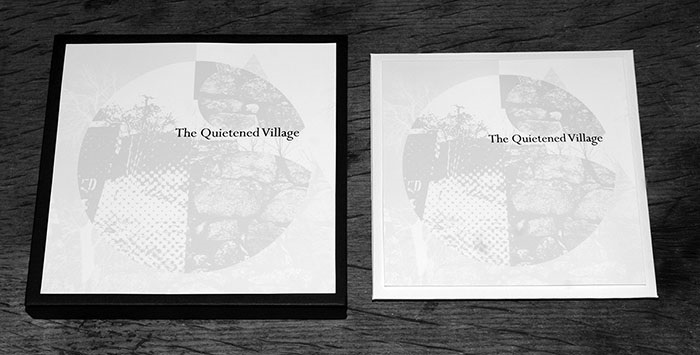
The daily on-line posts from A Year in the Country provided twelve months of eclectic imaginings on the unsettled bucolic a while back and in April comes an album of sonic accompaniment featuring a goodly mix of collaborators, The Quietened Village: "a study of and reflection on the lost, disappeared and once were homes and hamlets that have wandered off the maps or that have become shells of their former lives and times".
Further audio reports from the landscape edge come in the shape of Justin Hopper's poetry and sound project, I Made Some Low Enquiries, featuring none-other than folk legend Shirley Collins and available from the English Heretic website.
Radio has become my day-time company in recent months, through the fountainhead that is BBC iPlayer. Melvyn Bragg curating In Our Time, 6 Music's Freak Zone, Radio 4's aurally-charged production of The Stone Tape, Late Junction eclectica on Radio 3, The Children of Witchwood and old Sherlock Holmes episodes on Radio 4 Extra; the list goes on. Current enjoyment is provided by music journalist Laura Barton's exploration of the relationship between landscape and music across the British Isles in her Radio 4 documentary series, as described further here.
The music of the crags and cliffs of Red Daren and Black Daren is a song of stone. Here in the Olchon Valley is found the geological rim of England as western Herefordshire sheds its Anglo-Saxon facade and bleeds into the Black Mountains of Wales. A recent Sunday morning jaunt amongst the Old Red Sandstone passed through this hushed borderland, climbing to the Hatterall ridge; Hatterall, perhaps, bastardised from At y Heu: 'towards the sun'.
And back home the summit of my books to read mountain has moved further out of reach with the addition of Time's Anvil: England, Archaeology and the Imagination by Richard Morris, Bloody Old Britain by Kitty Hauser, Anna Pavord's Landskipping, John Lewis-Stempel's Meadowland and The Buried Giant by Kazuo Ishiguro.
Right, back on the Monk's Trod now for me.
A good number of interesting things have been kindly brought to my attention or stumbled across already this year, and here is something of a cartulary (damn, can't shake off my research head!).
"And I rose up, and knew that I was tired, and continued my journey”. Artist and composer Martin A. Smith has produced a new film, Secretly sharing the landscape with the living, exploring part of the Icknield Way in Buckinghamshire, following in the fecund footsteps of Edward Thomas:
You can find out more about Martin's work here.
The daily on-line posts from A Year in the Country provided twelve months of eclectic imaginings on the unsettled bucolic a while back and in April comes an album of sonic accompaniment featuring a goodly mix of collaborators, The Quietened Village: "a study of and reflection on the lost, disappeared and once were homes and hamlets that have wandered off the maps or that have become shells of their former lives and times".
Further audio reports from the landscape edge come in the shape of Justin Hopper's poetry and sound project, I Made Some Low Enquiries, featuring none-other than folk legend Shirley Collins and available from the English Heretic website.
Radio has become my day-time company in recent months, through the fountainhead that is BBC iPlayer. Melvyn Bragg curating In Our Time, 6 Music's Freak Zone, Radio 4's aurally-charged production of The Stone Tape, Late Junction eclectica on Radio 3, The Children of Witchwood and old Sherlock Holmes episodes on Radio 4 Extra; the list goes on. Current enjoyment is provided by music journalist Laura Barton's exploration of the relationship between landscape and music across the British Isles in her Radio 4 documentary series, as described further here.
The music of the crags and cliffs of Red Daren and Black Daren is a song of stone. Here in the Olchon Valley is found the geological rim of England as western Herefordshire sheds its Anglo-Saxon facade and bleeds into the Black Mountains of Wales. A recent Sunday morning jaunt amongst the Old Red Sandstone passed through this hushed borderland, climbing to the Hatterall ridge; Hatterall, perhaps, bastardised from At y Heu: 'towards the sun'.
And back home the summit of my books to read mountain has moved further out of reach with the addition of Time's Anvil: England, Archaeology and the Imagination by Richard Morris, Bloody Old Britain by Kitty Hauser, Anna Pavord's Landskipping, John Lewis-Stempel's Meadowland and The Buried Giant by Kazuo Ishiguro.
Right, back on the Monk's Trod now for me.
Tuesday, 26 January 2016
PhD research paper #3. Further landscape perspectives: experience and perception
From time to time I will post 'bite size' chunks of the material I am preparing for my PhD thesis: works in progress, but content which I feel may be of interest to a wider audience. All will be very much draft versions, not necessarily - probably not - reflecting the final wording that will eventually appear in the Thesis. In-text references are included but a full bibliography is not. This paper is based on a section of the initial literature review and follows on from my research paper #1 and research paper #2.
Further landscape perspectives: experience and perception
Literary and artistic representations
‘A humble
chapel of David the Archbishop (St David) formerly stood decorated only with
moss and ivy … a situation truly calculated for religion and more adapted to
canonical discipline than all the monasteries in Britain.’
(Gerald
of Wales in Thorpe 1978, 96-7).
In the
above description of the location of Llanthony Priory in Monmouthshire Gerald of Wales is not
simply reporting the topographical features that he observed, his words are
heavy with symbolism. Allegorical descriptions of the landscape and setting of
monasteries were common in contemporary writing during the monastic period. For
instance, Clarke (2006, 68) has shown how the
fenland houses of Glastonbury (Somerset), Ely (Norfolk) and Ramsey (Kent) exploited the
symbolic potential of their local watery landscapes (and the practical
transformations through drainage and cultivation which they were enacting) in
twelfth and thirteenth century texts and pastoral conventions which ‘transform
the realities of topography and monastic land management into allegories of
spiritual cultivation and triumph’. Later
representations of medieval monastic life and landscape in art and literature
that go beyond using monasticism as a suitably archaic and esoteric setting for
mystery and Gothic intrigue[1]
are relatively sparse. One writer who spent much time in monasteries across
Europe during the middle twentieth century was Patrick Leigh Fermor. In his
vivid and empathetic prose can be found descriptions which evoke the imagined
monastic landscape of the Middle Ages. This account of his arrival at Abbeye de
la Trappe in Normandy is worth quoting at length as illustration:
‘It (the
abbey) dwindled off into farm buildings, and came to an end in the fields where
thousands of turnips led their secret lives … Among the furrows an image
mouldered on its pedestal; and under a sky of clouded steel, the rooks cawed
and wheeled and settled. Across the December landscape, flat and waterlogged
with its clumps of drizzling coppice and barren-looking pasture-land, ran a
rutted path which disappeared beneath an avenue of elm-trees … Isolated monks,
all of them hooded and clogged, at work in the fields, ploughing or chopping
wood, dotted this sodden panorama and the report of their falling axes reached
the ear long seconds after the visual impact. Others were driving long herds of
cattle to graze. Two of them would converse for a few seconds in their
extraordinary semaphore, and then ‘Viens,
la blanche!’ or, ‘á droite, grosse
bête!’ would break the silence as a cow or a laggard cart-horse was urged
through a gap in a hedge. Then the stillness fell once again’ (Fermor 1988,
67).
More generally, the combination of landscape,
nature and sense of place with language, music and imagery is one of the most
potent and enduring alliances within artistic and literary practice. As Grigson
(1984, xiii) has noted, it is artists, folklorists, poets, musicians and
writers who are often able to most memorably articulate ‘an immediate record …
of observations, of something seen, something sensed, something or other felt
and enjoyed, in the country around them’. Here we can see another largely
untapped potential confluence with landscape
archaeology practice.[2]
Academic
analysis of art and literature has tended to view the landscape as
inferior and subordinate to the main subject of the work (human activity,
buildings, animals and so on). Landscape, as background, organises or frames
the subject to give context or definition, but interpretation of its
intrinsic significance is often overlooked (Andrews 1999, 5-7); an echo of the aforementioned
peripheral position of landscape in the study of monastic sites and their
history until relatively recently. In an art history context, for instance, the traditional
position presupposes a straightforward relationship between landscape, or a good view, and art, with the painterly
image as the prime expression of this.[3] The artistic
representation elicits an instinctive human response, which may be culturally
influenced but essentially comes from within. A more sophisticated constructionist view has since become
dominant, emphasising how we select, edit and interpret what we see. In Andrews
(1999, 1-3, 15) formulation, the process of producing an artistic
representation of a particular scene is twofold: ‘Land into landscape; landscape into art’, achieving a
combining of the actual terrain in view and the pictorial image; in effect ‘the
dissolving of the two together’.
A particularly fruitful
exemplar of the symbiosis between art and landscape is Romanticism, a new way
of looking at the world aesthetically (the gaze or view) and the relationship
between nature and humanity which developed in the later eighteenth and early
nineteenth century, influenced by, but also reacting against, the scientific
rationality of the Enlightenment period (Johnson 2007b, 18-33). A
transformation in envisioning that still resonates: as Austin (2013, 4) points
out: ‘The monastic ruin is a key graphic, literary and architectural component
of that change still strongly influencing our management and visiting of
monuments in the contemporary landscape’. A number of notable figures
associated with the Romantic Movement produced work in and about places and
landscapes in the study area (as explored in Knight 1999; Moore 2007). William
Gilpin is often credited with energising the popularity of notions of the
picturesque and sublime through the publication of his Observations on the River Wye and Several Parts of South Wales in
1782, after which the Wye valley was firmly established on the domestic Grand
Tour circuit for those who were both fashionable and wealthy. Gilpin (2005, 40)
describes the landscape setting of Tintern Abbey in classic romantic terms
thus: ‘The woods, and glades intermixed; the winding of the river; the variety
of the ground; the splendid ruin, contrasted with the objects of nature; and
the elegant line formed by the summits of the hills, which include the whole;
make altogether a very inchanting (sic) piece of scenery’.
It was on a walking tour in 1793 that William
Wordsworth passed through the Wye valley and was inspired to write Lines Written a Few Miles above Tintern
Abbey, the final poem in his ground-breaking Lyrical Ballads collection with Coleridge (Daiches and Flower 1979, 119). Wordsworth focus was less on the
narrow aesthetic vision of Gilpin and was guided by a more physical and
emotional immersion in the landscape, to him the ruined abbey resonated with
‘the still sad music of humanity’ (Hardyment 2012, 76). The ruins of monastic
houses featured regularly in the prodigious output of JMW Turner and he painted
Llanthony Priory, Tintern Abbey and other topographical sites in the area. Of
course, Turner and other landscape painters of the time were not seeking to
develop an accurate documentary record of what they saw. Nevertheless, their
work provides not only much topographical evidence (see Figure 1) but is also
of value to the historian as a nuanced commentary on the tensions between the
emerging new world of agri-industrial process and infrastructure and the
buildings and land-use of earlier ages (Hamilton 2003, 11).
Figure 1: Llanthony Abbey,
Cwmyoy, Monmouthshire by JMW Turner, 1794. The painting shows the surrounding
hills higher and more precipitous than in reality, with a similarly
romanticised river scene in the foreground. However, also clearly represented
is the still now extant curvilinear enclosure on Loxey Tump above the ruins,
which may originate as a medieval sheep corral operated by the Priory.
Both
Llanthony and Tintern have continued to be the subject of much artistic work,
inspired by the combination of romantic monastic ruins, a legacy of
spirituality and dramatic landscape setting.[4] The study area as a whole
also has a rich heritage of poetry, prose and folklore with a strong sense of
place, a repository recording encounters and experiences captured whilst moving
through the landscape which can help to bridge the gap between landscape archaeology and cultural theories of
identity, memory and perception embodied in the landscape (Dunham 2007, 183).[5] There is also, as
Macfarlane (2014, xxviii-xxix) highlights, a more esoteric legacy: ‘Perhaps
because of its combination of wildness (high ground) and habitability (rich
valleys), the southern English-Welsh borderland is a region that has bred a
peculiar number of seers, savants and mystics’.[6] For instance, Alfred
Watkins fieldwork in pursuit of his fanciful and discredited ley-lines theory
during the 1920s can be seen as, in Matless’ words, ‘… an eccentric
mirror-image of field archaeology’ as it was being developed and codified by
Crawford and others at the time (1998, 82). An additional relevance is that most
of the topographical descriptions and illustrations that appeared in Watkins’
book, The Old Straight Track (1925) are
of the south-eastern Welsh Marches. The symbolism and referencing of temporal
heritage within the landscape in artistic and literary representation, specifically in relation to the monastic legacy of the study area, would seem a
fruitful evidence-base for further investigation.
An example of an evolving literary conceptualisation of landscape
that can also be drawn into this discussion is found in the flowering of what
has been, somewhat misleadingly, called the New Nature Writing of the last
decade or so (Procter 2014, 78). Perhaps in contradistinction to the long
tradition of British natural history and topographical writing which has
provided a balm of rural idyll for an increasingly urbanised population,
contemporary writing on nature, landscape and place is in many ways coaxial to the cultural
geographical responses to landscape discussed later in this section. Iain Sinclair
has described natural historian Richard Mabey as ‘the unacknowledged pivot’ between
an earlier tradition of environmental and nature writing and both the more
experiential ‘new nature’ genre and those described as psycho-geographers
(Hardyment 2012, 183; Mabey 2010, 11).[7] All
share a rejection of the narrow confines of subject-specific discourse and a
recognition of the interplay between human culture and the natural environment,[8] reviving
the cadence of earlier generations of British writers such as John Clare,
Richard Jefferies, Thomas Hardy and Edward Thomas (Procter 2014, 78).[9]
As
this brief and partial synopsis has shown, sense of place is a vital component
in a remarkably wide range of artistic and literary work. Topographical
knowledge of the places and landscapes that form the subject matter can certainly
assist in our understanding of art, music and writing (Daiches and Flower 1979,
7). However, the relationship is reciprocal: an analysis of art and literature
inspired by or interpreting place can help our understanding of how these
landscapes, and perceptions of them, have evolved over time.
Cultural geography and landscape
A
return now to Johnson’s (2007) assertion that well-established empirical
techniques and post-modern experiential approaches need not be mutually
exclusive when studying historic landscapes. Both, in fact, embody the ancient
Greek notion of theoria: to look, to
contemplate, to speculate; or, in Walter’s (1988, 19-20) words, ‘a complex but
active mode of observation’. The rich potential, largely untapped,[10] to blend cultural
geographical discourse on how places are perceived, experienced and remembered
with a more conventional landscape
archaeology approach, as advocated by Fairclough and Johnson and outlined in my research paper #1 will
now be examined (with due regard to the sage warnings from Fleming and others
on the need for a bedrock of empirical context and substance when considering
landscape perception).
A
central concern of the New Geography that developed during the late 1960s and
through to the early 1980s was to reframe notions of space, place and landscape
through the prism of experiential perspectives, as articulated, for instance, through the
concept of phenomenology. This
approach viewed the environment as more than just a passive backdrop or
external object of the spectator’s gaze; providing a challenge to more traditional ideas
of landscape as simply a way of seeing the world or a repository of empirical
material data (Creswell 2004, 12-13; Tilley 1994, 10; Wylie 2007, 144). Such a
paradigm drew on European philosophy concerned with the nature of existence, in
particular the concepts of dwelling, being in the world and embodiment, the
intertwining of self and landscape as the basis of experience as espoused by philosophical
theorists Martin Heidegger and Maurice Merleau-Ponty (Tilley 1994, 13-14; Wylie
2007, 140-151).
More
recently Tim Ingold has revived this questioning of the notion of landscape as
a way of seeing the world and the Cartesian duality between culture:nature and
observer:observed that has traditionally informed cultural geography,
anthropology, archaeology and Western philosophical thought as a whole (Ingold
2000, 189; Wylie 2007, 145). His challenge to this order is to build on
Heidegger’s ‘dwelling perspective’, binding nature and culture together whilst
also recognising the dynamism inherent within landscape processes: ‘It is
through being inhabited that the world becomes a meaningful environment’ (Ingold
2000, 173).[11]
Thus a ‘human ecodynamic’ approach is constructed, requiring an integrated
research methodology (McGlade 1999, 465).
That raw spatial entity
becomes landscape through perception and memory has been a central concern of
anthropology and cultural geography in recent times (Wylie 2007, 191). Landscapes
are increasingly seen as ‘a form of codification of history itself’ and, as
such, embody remembrance and invoke the past (Stewart and Stratham 2003, 1); or
rather, the physical and perceptual remains of multiple pasts, including those more
distant and open to different interpretations (Holtorf and Williams 2006, 237;
Shama 1996, 10; Tilley 1994, 11). However, as Holtorf and Williams (2006,
236-7) have identified, landscape
archaeology ‘rarely considers how memories (including mythologies,
genealogies as well as cultural, community, and personal histories) were
inherited, inhabited, invented and imagined through the landscape’. In reality,
physical experience of the landscape and local social customs, relations and
memory are indivisible. Furthermore, topographical reminders have often been
fundamental as a way of spatial remembering and interpreting in times of social
and economic change (Walsham 2011, 7; Whyte 2009, 2, 9). There is, therefore, considerable scope to more effectively connect and cross-reference the recording of material traces through archaeological fieldwork with evidence of how
landscapes have been remembered and reappropriated by successive generations,
through the interpretative layers provided by oral folk memories, antiquarian
investigation, Romantic artistic representation, the modern heritage industry
and so on (Holtorf and Williams 2006, 238-242) (see Figure 2).
Figure 2: The Stony Way, Tintern, Monmouthshire: A major
routeway connecting Tintern Abbey with its outlying granges and manors during
the monastic period, now a backwater recreational path but with the remnants of
its engineered medieval surface still clearly visible and echoed in the name of the path; its past also
remembered through inclusion in the Cistercian Way long distance walking route
(Author).
A
phenomenological approach to landscape, based on experience, memory and
perception has manifested itself widely across the humanities and artistic
practice, demonstrating its practical utilisation as a distinctive form of
landscape study that can supplement other approaches (Wylie 2013, 57, 61).[12] In an archaeological
context, phenomenology has been particularly pioneered in prehistoric studies
(see, for instance, Bradley 2000; Tilley 1994, 2004, 2010), where a coalescing
of anthropology, archaeology and performance practice has emerged (Wylie 2007,
169).[13] This can be seen as part
of a broader exploration of the social and political dimension of landscape now
firmly established in the archaeology of prehistory and its management as a
heritage resource (McGlade 1999, 459). For instance, as illustrated by
Darvill’s (1999, 116) advocacy of a ‘space-time-action model’ in which the
analysis of the physical distribution of sites and features is a starting point
for investigating social action and experience across the landscape rather than
an end in itself.
As
most comprehensively practiced and explained by Christopher Tilley (2004, 219),
the phenomenology of prehistoric landscapes is characterised by a tactile and
field-oriented approach, foregrounded by direct in situ encounters that go beyond
the standard interactions with artefacts, sites and landscapes of drawing
plans, photography, mapping and excavation: activities that disembody the
evidence from its landscape context through conversion into text and imagery,
producing what Thrift has described as ‘dead geographies’ (Wylie 2007, 171).
The aim is to reclaim landscape as a holistic term embracing body, place,
perception and the relationship between people and place, to identify an ‘intelligent
landscape’ in which the topography and physiography of land and thought are
distinct but linked (Tilley 1994, 14; 2004, 25). An approach Ingold
(2005, 122) has described as ‘a manifesto for a genuinely outdoor archaeology’,
a response to the paradox that much of the writing up, analysis and theorising
of archaeological fieldwork takes place indoors i.e. away from the experience
of being in and inhabiting the landscape under scrutiny, through sight, sound
and other senses and feelings.
Criticisms of the phenomenological approach to landscape
Such
approaches have not been without their critics and sceptics, indeed
phenomenology in particular has been viewed with suspicion by many in the
academic disciplines in which it has been practiced (Wylie 2007, 180). There has
been a perception that it amounts to little more than an ambiguous abstract
theory, removed from practical experience, lacking a clear and valid methodology[14] and dislocated from environmental,
socio-economic, historical, and indeed wider landscape, contexts (McGlade 1999,
461; Wylie 2007, 139-140, 180-1). Such claims are strongly refuted by its
advocates who counter that everyday experience and field-based practice are central
tenants of the approach. In Tilley’s (1994, 11) words it requires ‘a continuous
dialectic between ideas and empirical data’. In relation to its archaeological
application, Fleming (2007, 89) has questioned how well the fieldwork
methodology of the phenomenological approach has been established, in contrast
to the more clearly formulated and tested techniques of modern landscape archaeology. More specifically, the
veracity of claims made about the siting of, for example, certain Neolithic
monuments following phenomenological research has been queried (Barrett and Ko
2009, 275).
More
fundamentally, the charge has been levelled that there is an underpinning
romanticising of rural, pre-modern and non-Western ways of experiencing
landscape, with a simplistic and nostalgic view of the ‘more authentic’
engagement of the past in comparison to modern, detached, objective interaction
(Wylie 2007, 181-2). In reference to the medieval period in particular, Bull
(2005) has outlined the many pitfalls of applying a modern value system or even
a mock medieval interpretation to how
people thought and acted during the Middle Ages, an unconscious trap that it would
be easy for a phenomenological viewpoint to fall into.
The
tensions between landscape
archaeology and post-modernism in the form of phenomenology and other
post-processual theory were recorded in the series of exchanges between Fleming
and Johnson previously alluded to in research paper #1. This is a debate which could perhaps run and
run, but to the outside eye Fleming’s (2008, 76) even-handed conclusion that,
as with other disciplines across the humanities and social sciences,
post-modernism can bring refreshing innovation to existing landscape archaeology praxis rather
than replacing it seems to be a judgement that most could agree with.[15] Such a view seems to fit
well with Wylie’s (2007, 186) assertion that the phenomenological approach has ‘identified
new topical grounds and new forms of research practice, at once enriching and
diversifying the ambit of landscape studies’.
Psycho-geography and deep topography
A further layer of cultural
geographical thought will now be brought into the discussion: an approach to
landscape and place, psycho-geography, that has to date had limited convergence
with phenomenological ideas and practice, let alone those of landscape archaeology. In its archaeological
and anthropologist incarnations, phenomenology has generally concerned itself
with a rural context. In contrast, with its loose origins both in the English
literary tradition of radical
commentary on the underbelly of the city, largely centred on London,[16]
and the dérive (unplanned journey) of the Dadist and Situationist art and intellectual movements of
mid-twentieth century Paris, psycho-geography has largely remained resolutely
urban in focus (Coverley 2006, 12). The common ground between the two is
the focus on direct experiential engagement with spatial surroundings,
generally through the agency of walking.
Perhaps because it is quite nebulous and
resistant to definition, psycho-geography has become something of a catch-all
term, a meeting point for a number of ideas and traditions with interwoven
histories relating to the convergence of psychology and geography: the impact
of the geographical environment on the human mind, emotions and behaviours
(Coverley 2006, 10-11). In essence, psycho-geography provides a fresh way to
read and interpret geographical space and bring together normally disparate
subject-matter.[17]
The work of Iain Sinclair in political perambulations through contested spaces
in and around London has proved particularly influential (see, for example, Sinclair
2003, 2011), but perhaps the magnus
opus of a contemporary
emerging landscape philosophising that can be loosely aligned with the psycho-geographic
tradition is W.G. Sebald's The
Rings of Saturn (1995).
Sebald recounts a ground-breaking narrative of a long East Anglian walk that
becomes a portal for evocations of and meditations on an array of times, places
and people.[18] Young (2010, 24) has
commented that: ‘Both these authors are adept at springing out the hermetic and
esoteric histories lying latent in the landscape’.
Nick Papadimitriou is another writer who has been labelled as a psycho-geographer. In Scarp: In Search
of London’s Outer Limits (2012), he defines his approach
more specifically as Deep Topography.
This terminology could also be used to describe the work of writers and
researchers, largely operating outside of the academic arena, such as Keiller
(2013), Robinson (1990) and Self (2007). Exponents of a more nuanced counterpart
to psycho-geography, less shackled to its conceptual and urban prescriptions
though also an even less theoretically sharpened approach.[19]
Self (2007, 11-12) has described deep topography as ‘minutely detailed,
multi-level examinations of select locales that impact upon the writer’s own
microscopic inner-eye’, combining ecology, history, poetry and sociology. As Papadimitriou’s ventures into deep topography throughout
the Middlesex-Hertfordshire boundary lands and Sebald’s long existential walk
along the East Anglian coast have demonstrated, any landscape can in principle
be opened up to what Sinclair has described as: ‘psycho-geography lite.
It was a long way from the Situationists but it suited the English sentiment
about walking, deep-topography, historical scavenging’ (Kobek 2014, 7).[20]
Although psycho-geographical
texts and practice have attracted academic interest in recent years, this has
tended to be within the confines of cultural geography and literary studies and
focused on the urban experience.[21] There has been little
interaction with other disciplines traditionally concerned with landscape:
ecology, history, archaeology and so forth. It is perhaps worth speculating
that the critique of and suspicions around phenomenology outlined above would
be equally manifest in relation to psycho-geography and deep topography,
particularly as it is generally practised outside an academic or professional
setting. The underpinning philosophy and praxis here is perhaps though closer to more established
approaches to landscape and place than one might initially think as
archaeology, ecology and local history are all disciplines partially dependent
on a dedicated cadre of amateur enthusiasts. Self (2007, 12) has proclaimed
that practitioners of psycho-geography are ‘really only local historians with
an attitude problem’, though often viewed with suspicion, if noted at all, by
those in professional landscape study fraternities.
Experience and perception in the study of historic landscapes
The adoption of the types of approaches that explicitly examine experience and perception considered here has been somewhat under-developed in the study of historic landscapes, despite the fact that there would appear to be considerable scope for greater application in considering how people moved through and engaged with their surroundings (Gardiner and Rippon 2007, 6; Gilchrist 2009, 391; Holtorf and Williams 2006, 237). Examples would include Altenberg’s (2003) comparative consideration of space and identity in case studies drawn from perceived marginal areas of medieval Britain and Scandinavia, and Johnson’s (2002) adoption of a phenomenological approach to underscore his study of the role of castles as elite stage settings, reflective of a focus on symbolism when considering designed medieval landscapes. Nicola Whyte’s Inhabiting the Landscape: Place, Custom and Memory, 1500-1800 (2009) can also be cited as a novel example of landscape archaeology research that foregrounds understanding and integrating people’s perception, memory, interpretation and experience of landscape, rather than focussing more narrowly on economic and environmental factors to explain landscape evolution, rooted in evidence from detailed local case studies. As Whyte (2009, 5) contends: ‘Understanding the landscape, as it was ‘inhabited’, should not be confined to prehistory’.
Experience and perception in the study of historic landscapes
The adoption of the types of approaches that explicitly examine experience and perception considered here has been somewhat under-developed in the study of historic landscapes, despite the fact that there would appear to be considerable scope for greater application in considering how people moved through and engaged with their surroundings (Gardiner and Rippon 2007, 6; Gilchrist 2009, 391; Holtorf and Williams 2006, 237). Examples would include Altenberg’s (2003) comparative consideration of space and identity in case studies drawn from perceived marginal areas of medieval Britain and Scandinavia, and Johnson’s (2002) adoption of a phenomenological approach to underscore his study of the role of castles as elite stage settings, reflective of a focus on symbolism when considering designed medieval landscapes. Nicola Whyte’s Inhabiting the Landscape: Place, Custom and Memory, 1500-1800 (2009) can also be cited as a novel example of landscape archaeology research that foregrounds understanding and integrating people’s perception, memory, interpretation and experience of landscape, rather than focussing more narrowly on economic and environmental factors to explain landscape evolution, rooted in evidence from detailed local case studies. As Whyte (2009, 5) contends: ‘Understanding the landscape, as it was ‘inhabited’, should not be confined to prehistory’.
As Walsham (2011, 5) observes,
people in the early modern period did not have a polarised view of nature and
culture, they were indivisible in the landscape: ‘A supplementary source of
revelation’, imbued with meaning and memory. A recurring and on-going phenomena
that Tuan (2013) has characterised as ‘topophilia’, the connection and
interrelation between people and place. This intertwinedness can also be given
a voice through the combining of some of the perspectives drawn from cultural
geography identified here with landscape
archaeology practice; providing a freshness to the analysis of landscape
and place, through the enriched understanding of environment, culture and
meaning that interdisciplinarity can encourage (Cosgrove 2008, 3). The rich and
varied afterlife of the monastic estates in the study area for this project, coupled with the
artistic and literary output and folk memories that they generated, has
particular potential for the application of this more expansive landscape
perspective.
[1] For instance, The Monk: A Romance (1796) by M.G. Lewis, generally viewed as one
of the first Gothic novels; M. R. James’ ghost story, The Treasure of Abbot Thomas (1904); Umberto Eco’s The Name of the Rose (1983); the Cadfael (1977-1994) historical murder
mysteries of Edith Pargeter; and Casper David Friedrich’s painting,
The Abbey in the Oakwood (1810).
[2] For instance, landscape archaeology, is not represented amongst the
contributors to the multi-disciplinary discourse on landscape and art context in
DeLue, and Elkins edited volume, Landscape
Theory: The Art Seminar (2008).
[3] As articulated, for instance, in
Clark’s Landscape into Art (1966).
[4] As detailed in the hand list
brochures for the Sites of Inspiration:
Tintern Abbey and Llanthony Priory exhibitions at Abergavenny and Chepstow
Museums in 2014. The
Llanthony valley has been a particular foci for artists, notably during the
period in which sculptor and typographer Eric Gill established a bohemian
artistic-religious community at Capel-y-ffin in the 1920s.
[5] Evidence for which would include a rich
corpus of Anglo-Welsh folklore tales (Palmer 1998; Simpson 1976); the late
nineteenth century country diaries of the Reverend Francis Kilvert; the fiction
and non-fiction of Raymond Williams: see, for instance, People of the Black Mountains I: The Beginning, and II: the Eggs of the Eagle (1990a,1990b) and The Country and the City (2011); and Bruce Chatwin’s On the Black Hill (1998), Owen Sheers Resistance (2007) and Iain Sinclair’s Landor’s Tower (2002): all novels
underwritten by their Welsh Marches and Black Mountains locations.
[6] As illustration, Macfarlane name-checks
William Langland, Thomas Traherne,
Henry Vaughan, John Dee, Arthur Machan and Alfred Watkins. Macfarlane has
written of a contemporary convergence of psycho-geography, ecology,
archaeology, mythology and hauntology more generally in British culture in his
article, This Spectred Isle (2015).
[7] Mabey’s prolific output includes a 1986 biography of Gilbert White (eighteenth century
parson-naturalist and author of the Ur-text of British natural history
writing, Natural
History and Antiquities of Selborne, 1798), The Unofficial Countryside
(1973), a seminal exploration of the
nature in urban edgelands, and Nature
Cure (2005), a treatise on the
positive impact of the natural world and sense of place on the human condition.
[8] For example, see Deakin (2007),
Macfarlane (2007, 2012, 2015): evidence of a synergy with the deep topography
and psycho-geography of Papademitrou, Sebald, Sinclair and others discussed further
on in this section.
[9] Books such as Jefferies’ Wild Life
in a Southern County (2011) and Thomas’ The
South Country (2009), chronicled not only flora and fauna but also the
human life of communities whose everyday lives were immersed in the landscape,
based on intimate knowledge and capacious walking.
[10] For instance, the overview of
methodological approaches and practical
guide to investigating medieval rural settlements in Christie, and Stamper’s
edited volume, Medieval Rural Settlement:
Britain and Ireland AD800-1600 (2011), contain no mention of
phenomenological or other cultural geographical approaches (Jones and Hooke
2011; Lewis 2011).
[11] Somewhat puzzlingly, Ingold used a painting
of a medieval scene, The Harvester by
Pieter Bruegel the Elder (1565), rather than direct experience to demonstrate being in the landscape (Gilchrist 2009, 391-392).
[12] Examples would include: Ingold’s
(2000) already mentioned application in anthropology; Land Art based on bodily
contact and experience of landscape as practised by, for example, Andy Goldsworthy,
Richard Long and Robert Smithson; Richard Skelton’s experimental musical and
literary projects in specific locations using sound, art, photography and
archive research to reflect on the landscape and its inhabitants (Hudson 2015,
65-6; Skelton 2010); practice and performance studies involving
direct participation of walking, driving, climbing, gardening etc.; and movement
and mobility studies, connecting eye, body and land (Lund 2012; Pearson and
Shanks 1997; Wylie 2005; 2007, 166, 177; 2013, 61).
[13] The experimental encounters
with sites, materials and landscapes in Shanks and Pearson’s Theatre/ Archaeology (2001) being a
prime example.
[14] Tilley’s field methods have been
criticised for being overly dependent on the perception and interpretation of
the individual researcher, an over-representation of visual perception at the
expense of other forms of experience and an over-emphasis on experiencing
specific monuments rather than the wider landscape (Altenberg 2003, 27-28).
[15] It is also interesting to note that one
of the few examples of an experiential approach to historic landscape fieldwork
is provided by Fleming himself in a novel article on medieval long-distance roads that uses a modern journey on horse-back along such a track as part of its
evidence base, though the use of this methodology is not elaborated upon
(Fleming 2010b).
[16] Notably the writings of those whom
Ackroyd (2004, 308-14) has termed ‘Cockney Visionaries’, from Chaucer and
Bunyan to Defoe, Blake and Dickens. A tradition taken forward into the modern
age through the contrasting work and style of Ackroyd himself, Ballard,
Sinclair and Keiller (Coverley 2006, 25-9).
[17] For instance, Solnit’s
(2001) writings on the history, philosophy and psychology of walking and Farley
and Symmons Roberts (2011) exploration of the minutia of England’s urban
edgelands.
[18] Which can be compared with film-maker
Werner Herzog’s record of his walk from Munich to Paris, Of Walking in Ice (1991), and also has echoes of Hilaire Belloc’s
(1945, 1958) accounts of his proto-psycho-geographical neo-pilgrimages from
Canterbury to Winchester and from the Upper Mosselle valley in France to Rome
at the turn of the twentieth century.
[19] A Google Scholar search for deep topography yields plentiful
references to oceanographic research but none for cultural geography or
landscape study.
[20] A further example
would be Worpole and Orton's (2005, 2013) exploration of the marginal
countryside of the estuary indented, marsh rich and semi-industrial Essex
coastline: a liminal landscape in close proximity to, but also estranged from,
the urban expanse of London.
[21] For example, Richardson’s Walking Inside Out: Contemporary British
Psychogeography (2015) and Garrett’s examination of the practice of urban
exploration (urbex) or place-hacking, Explore Everything:
Place-Hacking the City (2013).
Subscribe to:
Posts (Atom)